


The Recapitalisation Decision: A Bold Step Towards Reform
Consider a bank licensed as an international bank in 2005 with a capital base of ₦50 billion, when the exchange rate was approximately ₦130 to the US dollar. If that same capital base remained unchanged while the exchange rate moved above ₦1,500 to the dollar, the bank’s international purchasing power would be dramatically reduced.
Although the nominal amount might remain ₦50 billion, its real capacity to support large-scale projects would have diminished considerably. How could such a bank finance the ambitions of a trillion-dollar economy? How could it support a major power plant, a deep-sea port, a large mechanised farm or an affordable mortgage system for millions of aspiring homeowners?
The challenge was clear. When banks lack sufficient capital to absorb risk and finance major investments, they tend to concentrate on safer, shorter-term opportunities. Meanwhile, manufacturers, farmers, technology entrepreneurs and other productive businesses struggle to obtain affordable, long-term credit.
The manufacturer in Nnewi, the farmer in Kebbi and the technology entrepreneur in Lagos all need access to finance to expand their operations, employ more people and contribute to national development. Without a strong banking system, those ambitions become much harder to realise.
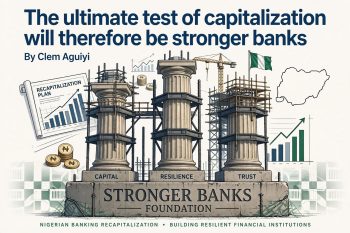
In March 2024, the CBN announced a new banking recapitalisation programme designed to strengthen the capital base of Nigerian banks. Under the programme, the minimum capital requirements were set at: ₦500 billion for international commercial banks; ₦200 billion for national commercial banks; ₦50 billion for regional commercial banks. The programme established a deadline of March 2026 for banks to meet the applicable requirements. The announcement generated debate across the financial sector.
Some bankers questioned whether the requirements were too demanding, while some analysts raised concerns about the implications for smaller institutions and financial stability. Yet the underlying objective was significant: Nigerian banks needed stronger financial foundations to support a growing economy and withstand future shocks. Cardoso’s approach reflected a central principle of banking reform: a country seeking economic transformation must ensure that its financial institutions possess the capacity to support that transformation. The recapitalisation programme was not simply about making banks bigger. It was about making them stronger, more resilient and better equipped to finance productive economic activity.










Leave a Reply