


Tel: 08034747898
There is a time to lock the vault, and there is a time to unlock it. Great central banking is knowing when to do which.
In September 2023, when Olayemi Cardoso walked into the Central Bank of Nigeria headquarters in Abuja, he met a vault that was bleeding and an economy on fire. Inflation was 26.72 percent and racing toward 34.19 percent, the highest in 28 years. The naira had collapsed from N700 to over N1,600 to a dollar. Ways and Means – the illegal printing of money for government – had ballooned to N27 trillion. Money supply was growing at over 50 percent. Too much naira was chasing too few goods, too few dollars, and too much speculation. The naira was dying, and with it, the value of every deposit in every bank.
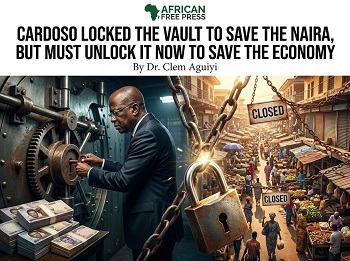
Cardoso had to act. And he acted like a firefighter who knows you cannot save the furniture until you stop the fire. He locked the vault.
He locked it tighter than any CBN Governor in Nigerian history.
First, he raised Cash Reserve Ratio to 45 percent for commercial banks and 75 percent for public sector deposits. For every N100 you deposited in Zenith, Access or GTCO, N45 was instantly seized and locked at CBN, yielding zero. As of December 2025, with industry deposits at N110.19 trillion, it meant about N49 trillion – almost half of all Nigerians’ money – was frozen at CBN. It could not be used to buy dollars, it could not be used to chase prices, it could not fuel inflation. It was dead money, deliberately killed to save the currency.
Second, he raised Monetary Policy Rate to 26.5 percent. At that rate, banks’ cost of funds rose to 20-22 percent, so they had to lend at 30-35 percent to make profit. No legitimate business could borrow at that rate. So banks stopped lending. They took the little money left after CRR and bought Federal Government Treasury Bills and OMO Bills at 22 percent risk-free. It was safer to fund government deficit than to fund a factory in Nnewi.
Third, he mopped up over N10 trillion through OMO auctions and cut Loan-to-Deposit Ratio from 65 percent to 50 percent. In 2019, CBN forced banks to lend 65 percent of deposits to grow the economy. In 2024, Cardoso reversed it and told banks to lend only 50 percent. The message was clear: stop creating money, stop lending, hold cash.
It was brutal. Private sector credit collapsed in real terms. SME lending fell. Non-performing loans rose to 7.51 percent, above the 5 percent threshold. Businesses groaned. But it worked.
Inflation fell from 34.19 percent to 20.12 percent by August 2025. Naira stabilized around N1,500/$. Foreign reserves rose. Foreign portfolio investors returned. And trust returned to the banking system – which is why deposits surged to N105.01 trillion by September 2026 in just five banks alone. Nigerians kept money in banks again because they believed money would retain value. The vault was saved. The naira was saved.
But now, keeping the vault locked is becoming more dangerous than opening it.
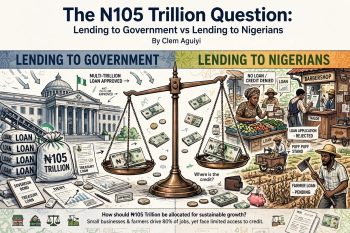
We have created a cruel paradox: a mountain of deposits sitting on a valley of poverty. Five banks control N94.87 trillion in assets, 57.19 percent of industry assets, and N64.39 trillion in deposits, 58.44 percent of all deposits. They have N105 trillion in deposits but industry loan-to-deposit ratios are 27 percent at GTCO, 32 percent at UBA, 39 percent at Zenith and Access. For every N100 deposited, only N35-N40 reaches the real economy. About 22 percent of all banking assets, according to World Bank, are parked in government securities. Banks are swimming in cash, but factories are thirsty for credit.
The recapitalisation exercise that ended March 31, 2026, raised N4.65 trillion. Banks are stronger than ever. Liquidity ratio is 60.27 percent. Capital is solid. The fire of inflation is now controlled. Month-on-month inflation is back to single digit. Keeping CRR at 45 percent and MPR at 23 percent today is like keeping a patient on oxygen after he has recovered – you will suffocate him.
This is why Cardoso must now unlock the vault, gradually and intelligently, to save the economy.
How?
He has already started. In September 2026, MPR was cut to 23 percent. In April 2026, DMBs and DFIs credit to SMEs rose to N199 billion from N153 billion in March. CBN has deployed a new Supervisory Examination Application using AI to monitor loan books in real-time. It has ended forbearance, enforced Single Obligor Limits, and launched a Risk-Based Capital Adequacy Framework in March 2026 that punishes banks that take concentrated risks in oil and gas and rewards those that diversify into SMEs.
But more is needed, and urgently.
First, CBN must replace blanket CRR with tiered CRR. Banks with LDR above 60 percent and NPL below 5 percent should enjoy CRR of 25 percent. Banks with LDR below 40 percent should keep 45 percent. Reward lending, punish hoarding. That alone will free N4-6 trillion without printing a kobo.
Second, assign risk-weight to excessive government securities. Today, T-Bills carry zero percent risk-weight. Banks need no capital to hold them. If CBN assigns 10 percent risk-weight to government securities above a threshold, banks will need more capital to hold T-Bills than to hold a manufacturing loan. They will lend.
Third, crush insider lending finally. CBN’s February 2025 Insider Credit Circular that forces directors with non-performing insider loans to resign must be fully enforced. When N1 trillion is freed from one chronic oil debtor, it can fund 100,000 SMEs.
Fourth, de-risk the borrower, not just the bank. Expand collateral registry, strengthen credit bureaus, enforce small claims courts, and provide 50 percent partial guarantees through BOI, DBN and MOFI. Banks don’t lend because lending is risky. Make it less risky.
Fifth, reduce OMO yields. Stop offering 22 percent risk-free to banks. When T-Bill yield drops to 14 percent, banks will find a way to lend to a factory at 20 percent.
Governor Cardoso is a reformer. History will record that he locked the vault to save the naira when others would have left it open to burn. History will also record what he does next.
Because a vault that is permanently locked does not save wealth. It buries it.
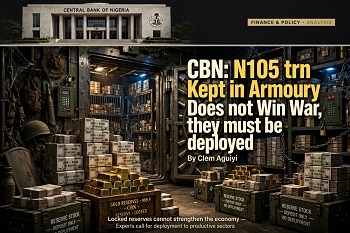
With N105 trillion in deposits, Nigeria has the ammunition to build a $1 trillion economy. But ammunition kept in the armoury does not win a war.
Cardoso locked the vault to save the naira. He must unlock it now to save the economy.








Leave a Reply