


By Dr. Clem Aguiyi – Analysis
Tel : 08034747898
In 2014, Nigeria rebased its economy and celebrated becoming Africa’s largest economy. In 2026, Nigeria’s banks can celebrate another rebasing – they now sit on a mountain of deposits larger than the GDP of most African nations.
N105.01 trillion.
That is the amount held by just five banks – Zenith, GTCO, First HoldCo, Stanbic IBTC and Ecobank Transnational – as of September 30, 2026. The entire industry holds N110.19 trillion. It is a testament to the trust Nigerians have in their banks, to the aggressive digital mobilisation by Access, Zenith and UBA, and to the safety-seeking behaviour in an inflationary economy.
But drive from Marina to Matori, from Onitsha Main Market to Aba Ariaria, and you will see the paradox. The vaults are full, the factories are empty.
We have built a mountain of deposits sitting on a valley of poverty.
*The Mathematics of Misery*
The World Bank’s Nigeria Development Update, released October 6, 2026, captured it clinically: only 32.6% of Nigerian banks’ total assets are net loans to customers. About 22% are invested in Federal Government and CBN securities – Treasury Bills, OMO Bills and Bonds that pay risk-free interest of up to 22%.
Look at the audited books:
– GTCO: N11.85 trillion deposits, N3.24 trillion loans. Loan-to-Deposit Ratio (LDR): 27%. Meaning 73% of your money is not lent to any business.
– UBA: N23.80 trillion deposits, N7.55 trillion loans. LDR: 32%.
– Zenith and Access: roughly N23-33 trillion deposits each, LDR of 39%.
– FirstBank: N17.89 trillion deposits, N9.56 trillion loans. LDR: 53% – the best of the lot, but still half the money is elsewhere.
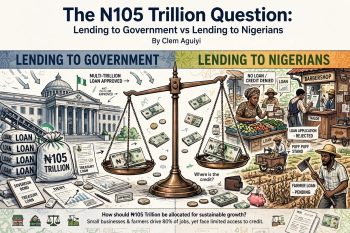
For every N100 a trader deposits in a big Nigerian bank, only N35-N40 goes to another Nigerian as a loan. The remaining N60-N65 is used to buy government debt, kept as cash with CBN, or parked as liquidity buffer. The banks have become funders of government deficit, not funders of economic growth. While industry gross credit is N58.36 trillion, industry deposits are N110.19 trillion. The gap is government securities.
The result? SMEs get credit at 30-35% interest for 90 days, while banks earn 20% risk-free from government for 364 days. Why lend to a risky shoemaker in Aba when you can lend to the Federal Government at no risk? This is why despite N4.65 trillion recapitalisation in March 2026 and record profits, credit to the private sector grew only 9% in real terms, while credit to government surged.
The poverty impact is direct. When banks don’t lend, businesses cannot expand. When businesses cannot expand, jobs are not created. When jobs are not created, deposits grow from salaries of few, not income of many. It is a vicious cycle: high deposits, low lending, high poverty.
*Why CBN Locked the Vault*
Governor Olayemi Cardoso did not create this problem, but his CBN had to lock the vault tighter to fight a bigger fire – inflation at 34% in 2024.
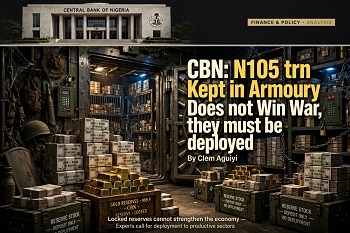
To fight inflation, CBN raised Cash Reserve Ratio to 45% for commercial banks and 75% for public sector deposits. It raised Monetary Policy Rate to 26.5% and kept it there for months. It mopped up over N10 trillion via OMO auctions.
What does 45% CRR mean? For every N100 you deposit in Zenith Bank, Zenith must immediately send N45 to CBN, where it yields zero. It can only use N55. From that N55, it must keep liquidity ratio, pay for branches, and then decide to lend. With MPR at 26.5%, the cost of funds is so high that a bank must lend at 32-35% to break even. No legitimate SME can survive at that rate. So banks rationally choose not to lend.
In April 2024, CBN also cut Loan-to-Deposit Ratio from 65% to 50%, officially to align with contractionary policy. The signal was clear: stop lending too much, keep cash. That policy saved the naira but starved the economy.
*How CBN Can Free Liquidity – A Five-Point Redemption Plan*
Now that inflation is trending down to 20.12% and MPR has been cut to 23% in September 2026, CBN has room to pivot from fighting inflation to feeding growth. Recapitalisation is done. The next battle is intermediation. Here is how CBN can free the mountain of liquidity into the valley.
*1. Drastically Cut CRR and Replace it with Risk-Based CRR:*
A blanket 45% CRR punishes good and bad banks alike. CBN should move to a tiered CRR: banks with LDR above 60% and NPL below 5% should enjoy CRR of 25%. Banks with LDR below 40% should keep 45%. This rewards lending and punishes hoarding. It will free an estimated N4-6 trillion instantly without printing money. The recently released CBN Annual Report shows industry liquidity ratio improved to 60.27% – there is enough liquidity to lower CRR safely.
*2. Enforce Risk-Based Capital to Penalise Government Securities Addiction:*
The new Risk-Based Capital Adequacy Framework released March 13, 2026, is a masterstroke. It must be fully enforced. Today, government securities carry 0% risk-weight, meaning banks need no capital to hold them. CBN should assign a small positive risk-weight – say 10% – to government securities above a threshold, and lower risk-weight for productive loans to agriculture, manufacturing and SMEs backed by collateral registry. If a bank needs more capital to hold T-Bills than to hold a manufacturing loan, it will lend.
*3. Total Crackdown on Insider and Concentrated Lending to Create Space:*
CBN data shows a huge chunk of NPLs are insider and oil & gas loans. The February 2025 Insider Credit Circular that forces directors with non-performing insider loans to resign and provision 100% must be pursued to its logical conclusion. Enforce Single Obligor Limit strictly. When N1 trillion is freed from one oil baron who is not repaying, it can fund 100,000 SMEs at N10 million each.
*4. De-risk the Real Sector, Not Just De-risk the Banks:*
Banks don’t lend because lending is risky. CBN cannot order them to lend at gunpoint – as IMF warned in 2019, forced LDR weakens balance sheets. Instead, CBN must make SME lending less risky: expand the collateral registry for movable assets, strengthen credit bureaus, enforce Small Claims Courts, and provide 50% partial guarantees through BOI, DBN and MOFI for loans to manufacturing and agriculture. In April 2026, DMBs and DFIs credit to SMEs rose to N199 billion from N153 billion because CBN upgraded obligor limits for DFIs and started convening BOI and Ministry of Industry. More of this is needed.
*5. Change OMO and Treasury Bills Market Structure:*
World Bank noted CBN has already started shifting OMO to shorter tenors and opening CBN bills to non-banks. It must go further. Stop offering 22% risk-free to banks. Reduce OMO issuance and force banks to seek yield in the private sector. When government securities yield drops to 14%, banks will find a way to lend to a factory at 20%.
*The Moment of Truth*
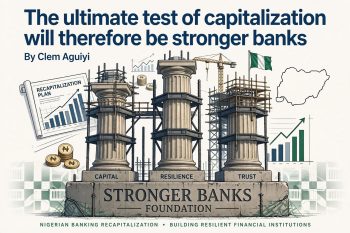
Nigeria’s banks are not weak. They are too strong and too cautious. With N105 trillion in deposits, N94.87 trillion in assets for the top five, and N4.65 trillion fresh capital, they have the muscle to finance Nigeria’s $1 trillion economy dream.
But muscle unused becomes fat.
Governor Cardoso’s team has done the hard part – stabilising the naira, recapitalising banks, cleaning insider abuse, and restoring confidence. That is why deposits surged to N105 trillion.
The second hard part remains: turning deposits into development. Turning vaults into factories. Turning a mountain of deposits sitting on a valley of poverty into a mountain of prosperity feeding a valley of opportunities.
That will be the true test of CBN oversight.









Leave a Reply