


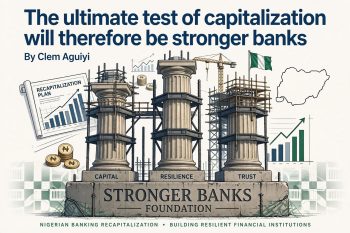
By Clem Aguiyi
Tel : 08034747898
It is the biggest mountain of cash in Nigeria’s corporate history.
N105.01 trillion.
That is how much Nigerians, businesses, governments and foreigners have parked in the vaults of just five banks as at September 30, 2026. It is more than double Nigeria’s entire 2025 federal budget. It is more than the GDP of Ghana, Kenya and Rwanda combined.
And it keeps growing.
According to The Nation Market Intelligence report released this week, Nigeria’s five Domestic Systemically Important Banks – the ones the Central Bank says are too big to fail – crossed the historic N100 trillion threshold in the third quarter. From N96.57 trillion in December 2025, they attracted a fresh N8.44 trillion in just nine months, an 8.7 per cent growth in an economy battling inflation, naira volatility and tight wallets. 4406
Who are the five?
This time, the list breaks the old FUGAZ tradition. The new deposit kings are *Ecobank Transnational Incorporated (ETI), Zenith Bank, First HoldCo, Guaranty Trust Holding Company (GTCO) and Stanbic IBTC Holdings.*
The old FUGAZ definition – FirstBank, UBA, GTCO, Access and Zenith – has been reshuffled by CBN’s Systemically Important Banks classification. Access and UBA still hold massive deposits, but in this specific Q3 2026 ranking focused on the most strategically important lenders, ETI and Stanbic IBTC made the cut.
*The Breakdown: Who Holds What?*
*1. ETI – The Pan-African Giant: N36.70 trillion*
ETI remains the elephant in the room. With operations in 33 African countries, its deposit base grew from N36.44 trillion to N36.70 trillion. It alone accounts for 35% of the N105 trillion pool. Its strength is its dollarized, diversified base across Francophone and Anglophone Africa, making it a hedge against naira risk.
*2. Zenith Bank – The Silent Compounder: N27.11 trillion*
Zenith added N2.78 trillion in nine months – the largest incremental gain – moving from N24.33 trillion to N27.11 trillion. Known for its obsessive cost discipline and corporate banking dominance, Zenith remains Nigeria’s most profitable deposit machine. Its retail deposits alone hit N11.56 trillion in 2025, the highest in the industry.
*3. First HoldCo – The Comeback Story: N22.91 trillion*
FirstBank’s parent grew from N18.88 trillion to N22.91 trillion, a jump of over N4 trillion. After years of governance issues, the oldest bank is winning back trust, especially in retail and public sector deposits.
*4. GTCO – The Efficiency King: N13.73 trillion*
GTCO grew from N12.55 trillion to N13.73 trillion. Though the smallest of the five, GTCO has the highest proportion of low-cost Current and Savings Account (CASA) deposits, meaning it pays the least interest on this huge sum – and makes the most profit from it.
*5. Stanbic IBTC – The New Entrant*
Stanbic’s inclusion shows the rise of the Tier-1.5 banks. Its pension, asset management and corporate banking ecosystem feeds cheap deposits into its vault.
*How Did They Do It? Three Forces*
*First, Fear and Safety.* In a year of bank recapitalisation anxiety, CBN revealed that five D-SIBs control 57.19% of total industry assets and 58.44% of total industry deposits – N64.39 trillion out of N110.19 trillion total industry deposits as of Dec 2025. Nigerians moved money from smaller banks, fintech wallets and under the mattress to the big names. Brand loyalty became financial survival. efeb
*Second, High Interest Rates and Naira Devaluation.* With MPR at record highs, banks offered 10-15% on term deposits. Many Nigerians sold dollars and kept naira in high-yield deposits. Also, when you convert ETI’s dollar deposits and Access, Zenith’s dollar domiciliary accounts at N1,600/$, the naira value balloons automatically.
*Third, Fintech as Feeders, Not Killers.* Despite OPay, Moniepoint and PalmPay processing $558 billion in transactions, banks remain the vault. Data shows six major banks’ retail deposits rose 24% to N39.01 trillion in 2025 alone, proving traditional banks still own the savings culture while fintechs own the payments. f88f
*The Paradox: N105 Trillion in Deposits, But Where is the Lending?*
This is the uncomfortable question in every boardroom. The Nation and BusinessDay analysis shows that for every N100 deposited, only about N40 goes into loans to businesses and individuals.
At GTCO, deposits were N11.85 trillion but loans were just N3.24 trillion – a loan-to-deposit ratio of 27%. At Zenith, N23.69 trillion deposits versus N9.37 trillion loans (39%). At Access, N33.10 trillion deposits versus N12.89 trillion loans (39%). 27bd
The rest? Packed into government Treasury Bills, Bonds and CBN OMO – safe, high-yielding government IOUs. Banks are lending to government, not growth. While industry total assets hit N161.28 trillion for the top five, combined loans were only N43.01 trillion, while securities and cash holdings dominate. 9b17
That is why CBN is tightening oversight. The five banks are too big to fail, but their failure to lend is making the economy fail slowly.
*What This Means For Nigeria*
With N105 trillion, these five banks have the firepower to fund a new Dangote Refinery every year. They have the liquidity backbone that kept Nigeria’s financial system stable through currency reforms. But until that liquidity is converted from deposits into factories, farms and SMEs, the N105 trillion will remain a powerful statistic that does not translate into prosperity.
The era of deposit mobilisation is over. The era of deposit deployment has just begun.











Leave a Reply