

Email: Totalpolitics@ymail.com Tel. 0803 474 7898
The Anambra Aerotropolis is being debated in exactly the wrong frame, and that is why the conversation keeps going in circles.
We keep pulling out the political map of Anambra, pointing to Umueri in the north, then to Orumba North in the south, counting LGAs, asking “whose turn is it,” and treating the project like another constituency project to be shared. That is a mistake. An aerotropolis is not a political gesture. It is economic infrastructure, and economic infrastructure does not respect state lines or senatorial zones. It follows flows: cargo, capital, time, and firms that need to get goods to market fast.
The project proposed under Governor Chukwuma Soludo’s Vision 2070 is not “a second airport” in the way people mean it. The plan is for an integrated aerotropolis on about 6,000 hectares, with an airport as the anchor, but built around industrial parks, logistics hubs, export processing zones, commercial districts and housing. The model is not new. It is Dubai’s Jebel Ali. It is Ethiopia’s Bole. The point of those places was never that the runway served only one city. The point was that the runway pulled an entire economy into one place because manufacturers, pharmaceutical firms, and exporters will not site in a location that cannot move goods in 24 to 48 hours.
That is the logic Anambra is trying to tap. Right now, firms deciding between Anambra, Ogun, or Lagos do not ask “which state do I like more.” They ask “what is my time-to-market and transport cost.” Without reliable air access, a big industrial park in the Southeast risks becoming another underused zone. With it, you can compete for the kind of investment that pays salaries year after year, not just during construction.
Yes, there is already the Chinua Achebe International Airport in Umueri. But airports are not like local government secretariats where one per state is enough. Lagos runs two parallel runways and multiple terminals. Delta, Kaduna and Rivers all operate more than one airfield. Nigeria itself has airports clustered within short distances and they function because aviation demand is not distributed by political boundaries. It is distributed by economic clusters. Orumba North sits closer to the dense business communities in southern Anambra, and to markets across Imo, Ebonyi and parts of Abia that currently drive to Enugu or Owerri. Building there does not split Anambra. It expands the catchment area of the aerotropolis economy beyond Anambra’s political borders.
And that is the critical point: the services of this airport will not serve Anambra people exclusively. No serious logistics hub ever does. Cargo from a pharmaceutical plant in Nnewi will leave through this airport, but so will produce from Ebonyi, manufactured goods from Aba, and inputs coming in for firms across the Southeast. Exporters do not check your voter’s card before they book air freight. Investors do not ask if a supplier is from Orumba before they sign a contract. They ask if the road connects, if power is stable, and if the plane can leave tonight. If we build this right, the economic radius becomes regional, not state. That is a feature, not a bug.
The criticism that it rests on “aspirational narratives” instead of current traffic numbers misses how economic geography works. You do not wait for traffic to appear before you build the infrastructure that creates it. You build the precondition, then the firms come because the cost equation has changed. Construction will create temporary jobs, and the permanent jobs in aviation, ground handling, warehousing, hospitality and manufacturing will follow if the cluster is credible. That is how agglomeration works. One factory attracts a supplier. One supplier attracts a logistics firm. One logistics firm makes the airport viable for the next exporter.
Of course this only works if we stop judging it by the political map. If we insist that every big project must be spread evenly across zones to satisfy political balancing, we will end up with many small things that do none of them well. If we treat land acquisition as a secret, we will create conflict and delay. If we measure success by ribbon-cutting instead of by cargo tonnage and private investment, we will repeat old mistakes.
But if we treat the Aerotropolis for what it is, economic infrastructure, then the questions change. The question is not “north vs south.” The question is: can this location, with the right roads, power and policy, become a node that pulls the Southeast into global supply chains? Can it reduce the cost of doing business for a manufacturer in Nnewi as much as for one in Aba? Can it make Anambra a place where a foreign buyer says “ship it from there” instead of “go to Lagos”?
That is the standard we should hold it to. The political map will tell us who governs the land. Economic geography will tell us whether the land creates wealth. The Anambra Aerotropolis deserves to be judged on the second one. If we get it right, it will not belong to Anambra alone. It will belong to every business in the region that needs speed, and that is exactly why we should build it.
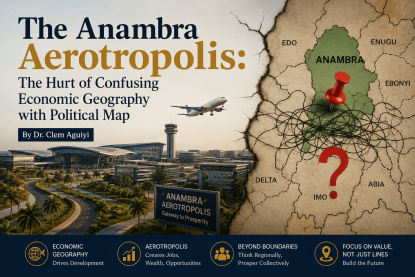
The Anambra Aerotropolis: The Hurt of Confusing Economic Geography with Political Map By Dr. Clem Aguiyi











Leave a Reply