


Tel: 08034747898
They are swimming in cash but the economy is gasping for credit.
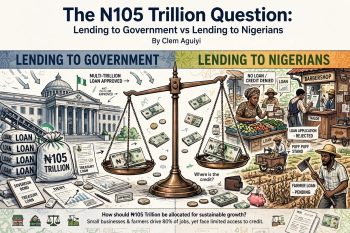
Nigeria’s top five banks now sit on N105.01 trillion in customer deposits as of September 2026. The entire banking industry holds N110.19 trillion in deposits. Yet, according to World Bank’s Nigeria Development Update (October 2026), only 32.6 per cent of banks’ total assets are loans to the real economy. About 22 per cent of all banking assets are parked in Federal Government and CBN securities – Treasury Bills and Bonds that pay risk-free interest.
The numbers are stark. GTCO held N11.85 trillion in deposits but gave only N3.24 trillion as loans – a loan-to-deposit ratio of 27%. Zenith Bank: N23.69 trillion deposits, N9.37 trillion loans (39%). Access Bank: N33.10 trillion deposits, N12.89 trillion loans (39%). UBA: N23.80 trillion deposits, N7.55 trillion loans (32%). For every N100 Nigerians deposit, less than N40 reaches a business, farmer or manufacturer. The rest funds government deficit.
This failure to lend is now Nigeria’s biggest economic bottleneck. SMEs cannot access credit at 30% interest. Manufacturers borrow at 35% while banks earn 22% risk-free from government. The result: factories close, unemployment rises, and banks declare record N4 trillion profits. It is profit without productivity.
Why do banks prefer government securities to businesses? The answer is rational but dangerous.
First, risk. The industry Non-Performing Loan ratio rose to 7.51% in December 2025, above CBN’s 5% threshold, after forbearance ended. Three banks alone reported N1.17 trillion bad loans in mid-2026. Oil and gas loans default at 44.9%. Banks would rather buy a safe T-Bill than chase a trader in Onitsha.
Second, CBN’s own policies. To fight inflation, CBN kept Cash Reserve Ratio at 45% for commercial banks and 75% for public sector deposits. That means for every N100 deposited, CBN locks N45 instantly. Then Monetary Policy Rate was at 26.5% for months. High CRR and high MPR made lending expensive and government borrowing irresistible.
Third, insider and concentration risk. The past is haunting the present. CBN discovered that much of the bad loans were insider-related – loans to directors, owners and related parties. That money never created jobs. That is why the apex bank is now angry.
*How CBN Oversight Is Changing The Equation*
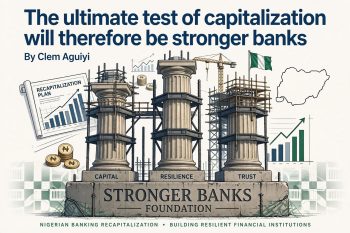
After the N4.65 trillion recapitalisation exercise that ended March 31, 2026 – where 33 banks met new capital thresholds of N500bn for international banks, N200bn for national banks – Governor Olayemi Cardoso said recapitalisation is not the end, it is the beginning of tougher oversight. The era of “raise money and go to sleep” is over.
CBN has rolled out five big sticks and carrots to force banks to lend again:
*1. Risk-Based Capital Framework (March 2026):*
The old system gave all banks the same capital adequacy target. The new system says: if you take higher risks, hold more capital. Banks with high exposure to oil and gas, forex, or concentrated lending must hold extra buffers. A bank that lends prudently to diversified SMEs will need less capital. It is designed to punish reckless lending to one billionaire and reward careful lending to 1,000 SMEs. The framework is anchored on BOFIA Sections 13 and 63 and requires annual stress tests – simulating oil price crash, naira devaluation, or director defaults.
*2. Total War on Insider Lending:*
In February 2025, CBN issued the Insider Credit Circular. Directors with non-performing insider loans must resign. Banks must provision 100% for insider loans within 18 months. Some bank owners and board members have already exited the industry in 2026. CBN also capped investments in foreign subsidiaries to 10% of shareholders’ funds to stop banks from using Nigerians’ deposits to fund risky London or Dubai ventures.
*3. End of Forbearance and Single Obligor Enforcement:*
CBN ended COVID-era forbearance that allowed banks to hide bad loans. It is now strictly enforcing Single Obligor Limit – the amount a bank can lend to one person or connected group. This will break the culture of 20% of loan book going to one oil magnate.
*4. Re-Calibrating LDR and Liquidity Tools:*
CBN’s Loan-to-Deposit Ratio policy has been volatile. In 2019 it forced banks to LDR of 65% to lend more. In April 2024, to fight inflation, it cut LDR to 50%. Now, World Bank notes, CBN is shifting OMO to shorter tenors and opening CBN bills to non-banks, so banks have less incentive to park funds with CBN. It also narrowed MPR corridor to +50/-300 basis points and cut MPR to 23% in September 2026 to make lending cheaper. In April 2026 alone, DMBs and DFIs credit to SMEs jumped to N199 billion from N153 billion in March.
*5. Digital Supervision:*
CBN has deployed a new Supervisory Examination Application powered by AI and data analytics. Examiners can now monitor banks’ loan books in real-time, not during annual visits. The system flags concentration risk, insider abuse and will preserve institutional memory.
*Will It Work?*
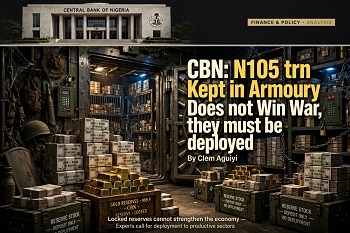
The World Bank is blunt: “Higher bank capital hasn’t boosted lending yet.” Banks are still stronger on paper but not in the market. Recapitalisation raised N4.65 trillion but that money is still in government securities.
The solution, analysts say, is to make lending less risky than not lending. That means CBN must lower CRR from 45% to free liquidity, enforce credit bureaus, strengthen collateral registry, and de-risk agriculture and manufacturing with partial guarantees through Bank of Industry and Development Bank of Nigeria.
Banks too must rediscover banking. The era of easy profit from Treasury Bills is ending. With N105 trillion in deposits, Nigerians are not asking for charity. They are asking for their money to work for them – in factories, farms and jobs.
If CBN succeeds, that N105 trillion could become Nigeria’s $1 trillion economy dream. If it fails, it will remain what it is today: a mountain of deposits sitting on a valley of poverty.








Leave a Reply