

Tel : 08034747898
If you had N105.01 trillion, what would you do with it?
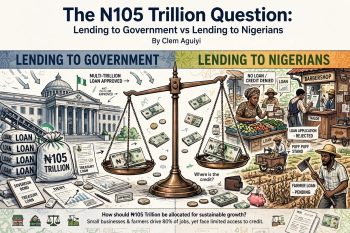
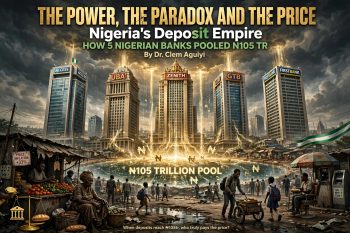
Nigeria’s five biggest banks – Zenith, GTCO, First HoldCo, Stanbic IBTC and ETI – had to answer that question as of September 30, 2026. Their answer was simple, rational, and devastating for the Nigerian economy: Lend it to the Federal Government, not to Nigerians.
According to World Bank Nigeria Development Update (October 2026), only 32.6% of Nigerian banks’ total assets are loans to customers. About 22% are investments in Federal Government and CBN securities – Treasury Bills, FGN Bonds, OMO Bills. In naira terms, that means out of N165.89 trillion total industry assets, about N36.5 trillion is lent to government, while only N58.36 trillion is lent to the entire private sector. Industry deposits are N110.19 trillion, but loans are just N58.36 trillion. Where is the remaining N52 trillion? In government securities and CBN vaults.
Why do banks prefer Treasury Bills to your business? The answer is in five cold calculations every bank treasurer makes before 9am.
*1. Zero Risk vs 100% Risk: The Capital Adequacy Trick*
Every loan a bank gives requires capital. CBN says a bank must hold at least 15% capital against risk-weighted assets. But not all assets have same risk-weight.
– Treasury Bill: Risk-weight = 0%. If a bank buys N10 billion T-Bills, it needs N0 extra capital. No capital charge.
– Loan to an SME or manufacturer: Risk-weight = 100%. If a bank lends N10 billion to an SME, it must hold N1.5 billion capital (15% of N10bn).
After recapitalisation where banks raised N4.65 trillion to meet N500bn (international) and N200bn (national) thresholds, banks want to preserve that capital, not consume it. So they buy T-Bills that consume zero capital, rather than lend to SMEs that consume heavy capital. It is regulatory arbitrage.
With the new Risk-Based Capital Framework released March 13, 2026, CBN is trying to fix this by assigning higher risk-weights to concentrated exposures and encouraging diversified SME lending, but T-Bills still enjoy zero risk-weight.
*2. Zero Default vs 7.51% Default: The NPL Nightmare*
As of December 2025, industry Non-Performing Loan ratio rose to 7.51%, above CBN’s 5% threshold, after forbearance ended. Three banks reported N1.17 trillion bad loans in mid-2026. Oil and gas loans default rate is 44.9%.
– Treasury Bill: Default rate = 0%. Federal Government has never defaulted on domestic T-Bills since independence. If government owes you N10 billion, you will get N10 billion plus interest on due date.
– Loan to business: Default rate = 7.51% average, but up to 30% for SMEs. If you lend N10 billion to 100 SMEs, N750 million may not come back. You must provision, chase, go to court, hire lawyers, and write off.
Why would a bank CEO risk his job and his bank’s capital to lend to a trader in Onitsha who may default, when he can lend to Wale Edun at the Ministry of Finance who will never default?
*3. 22% Return With No Work vs 35% Return With Heavy Work: The Lazy Banking Model*
At MPR 26.5%, CBN and DMO offered T-Bills at 20-22%. OMO Bills at similar rates.
– T-Bill: Return = 22% risk-free. No branch needed. No account officer. No monitoring. No fuel for generator. No site visit to farm in Anambra. You click on Bloomberg, buy N20 billion, and go to sleep. Interest accrues daily. On maturity, CBN credits you.
– SME Loan: Return = 32-35% nominal, but after deducting cost of funds (20-22%), provision (3-5%), operational cost (branch, staff, monitoring, 5%), and expected loss (7.51%), real return is 2-3%. And you must employ 10 relationship managers, run 50 branches, fuel generators, visit farms, chase repayments, and appear in court.
Banks are profit-maximising institutions. With Return on Equity pressure from new shareholders who gave them N4.65 trillion, they choose the easy 22% over the difficult 3%. This is why banks declare N4 trillion profits while manufacturing shrinks.
*4. Liquidity and CRR Magic: T-Bills Help You Avoid CBN Hammer*
Here is a secret most Nigerians don’t know: T-Bills help banks reduce CRR penalty.
When a bank fails to meet LDR (Loan-to-Deposit Ratio) of 50%, CBN debits 50% of the shortfall from its account as additional CRR. But investments in T-Bills are considered liquid assets, helping banks meet 30% liquidity ratio. So banks use T-Bills to kill two birds: earn interest and meet regulatory ratios without lending.
Also, at 45% CRR, for every N100 deposited, N45 is locked at zero interest. To make up for that dead money, banks need high-yielding liquid assets. T-Bills at 22% are perfect cover for the loss on CRR.
*5. No Insider Probe, No EFCC, No Scandal: The Safety of Anonymity*
A loan to a big man in Abuja can become a scandal. If it goes bad, CBN will probe insider related lending, EFCC may invite you, media will call you. Directors with non-performing insider loans now must resign under February 2025 Circular.
A T-Bill has no name. It is government. No probe. No scandal. No risk of being accused of giving loan to your cousin.
*The Cost to Nigeria*
This preference is rational for banks, but fatal for Nigeria.
When N36.5 trillion is locked in government securities, that is N36.5 trillion not building factories, not funding agriculture, not creating jobs. It is government borrowing your deposits to pay salaries and subsidies, while banks earn risk-free.
That is why we have a mountain of deposits (N105 trillion) sitting on a valley of poverty (133 million multi-dimensionally poor). Money is not scarce in Nigeria. Money is misallocated.
*How CBN Can Change the Equation*
CBN has started. It cut MPR to 23% in September 2026 to reduce T-Bill yields. It is opening OMO and CBN bills to non-banks so banks face competition. It has launched Risk-Based Capital Framework to penalise concentration.
But it must do more: assign 10% risk-weight to T-Bills above a threshold, cut CRR to 25% for banks that lend above 60% LDR, and provide 50% guarantees for SME loans via BOI/DBN so that lending to a factory becomes as safe as lending to government.
Until then, every treasurer will make the same choice at 9am: Buy T-Bill, not fund your business.
And the mountain will keep growing, while the valley keep growing down






Leave a Reply