

| Business & Economy
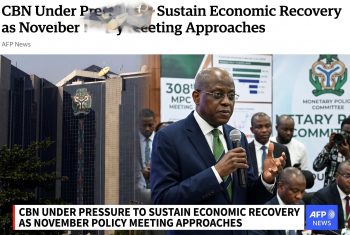
Nigeria’s Central Bank is heading towards another crucial monetary policy meeting as businesses, investors and households await its next move on interest rates, inflation and foreign exchange stability.
The Central Bank of Nigeria (CBN), under Governor Olayemi Cardoso, is facing the challenge of sustaining recent improvements in key economic indicators while ensuring that the benefits of monetary reforms translate into meaningful relief for ordinary Nigerians.
The bank’s 308th Monetary Policy Committee (MPC) meeting is scheduled for November 23 and 24, 2026, in Abuja. The meeting is expected to attract considerable attention because its outcome could influence borrowing costs, investment decisions, financial market expectations and the direction of the naira.
CBN’s Interest Rate Stands at 23 Per Cent
One of the most significant developments in Nigeria’s monetary policy this year was the CBN’s decision in September to reduce the Monetary Policy Rate (MPR) from 26.5 per cent to 23 per cent.
The 350-basis-point reduction followed signs of moderating inflation and improvements in the country’s external economic position.
The MPC also adjusted the standing facilities corridor to +50 and -300 basis points around the benchmark rate.
However, the bank retained the Cash Reserve Requirement (CRR) at 45 per cent for deposit money banks, 16 per cent for merchant banks and 75 per cent for non-Treasury Single Account public sector deposits.
The September decision marked an important adjustment in the bank’s monetary policy approach after an extended period of tight financial conditions.
Inflation Moderates, but Nigerians Still Face High Living Costs
Nigeria’s inflation rate recorded another decline in September 2026.
According to the National Bureau of Statistics, headline inflation fell to 14.63 per cent in September from 15.39 per cent in August.
Despite the improvement, food inflation remained elevated at 19.59 per cent, highlighting the continuing pressure on household budgets.
The distinction is important: a decline in the inflation rate does not mean that prices have returned to previous levels. It means that prices are increasing at a slower rate.
For millions of Nigerians, the real test of economic recovery will be whether food, transportation, housing and other essential expenses become more affordable.
The CBN’s monetary policy measures can help control inflation, but improvements in food supply, infrastructure, energy costs and domestic production will also be necessary.
CBN Urges Importers and Exporters to Follow Official Forex Channels
The CBN has renewed its call for importers and exporters to conduct foreign exchange transactions through authorised dealer banks and comply with the appropriate documentation requirements.
The bank maintains that proper documentation is essential to transparency, accountability and the effective functioning of Nigeria’s foreign exchange market.
A more transparent foreign exchange system could improve confidence among international investors and businesses while helping the authorities monitor legitimate demand for foreign currency.
However, maintaining confidence in the naira will require more than regulatory instructions. Consistent foreign exchange supply, stronger export earnings and predictable monetary policies remain important.
Digital Payments: Nigeria’s Financial System Continues to Expand
Another important development highlighted by the CBN is the expansion of Nigeria’s digital payment infrastructure.
The bank disclosed that Nigeria’s instant payment infrastructure processed approximately 11.2 billion transactions in 2025.
This figure demonstrates the growing importance of electronic payments in Nigeria’s financial system.
Digital transactions can improve payment efficiency, reduce dependence on cash and strengthen financial transparency.
The CBN has also highlighted opportunities for Nigerian businesses through regional payment initiatives, including the Pan-African Payment and Settlement System (PAPSS).
These developments could make cross-border payments easier and support trade between Nigeria and other African economies.
What Should Nigerians Expect from the November MPC Meeting?
The November 23–24 meeting will be particularly important because policymakers must decide whether the current 23 per cent interest rate remains appropriate.
The committee will have to consider several factors:
Whether inflation continues to moderate.
Whether the naira maintains relative stability in the foreign exchange market.
Whether the September interest rate adjustment has improved access to credit.
Whether food inflation and household living costs remain major concerns.
Whether monetary conditions can support economic growth without reigniting inflation.
A further reduction in interest rates could provide some relief to borrowers and businesses, although commercial banks do not automatically reduce lending rates whenever the CBN cuts its benchmark rate.
Conversely, retaining the current rate could indicate that policymakers want more evidence that inflation is under control before introducing further monetary easing.
The final decision will depend on the committee’s assessment of available economic data.
The Bigger Question: Will Monetary Reforms Improve Ordinary Nigerians’ Lives?
Under Cardoso’s leadership, the CBN has pursued reforms aimed at strengthening monetary discipline, improving foreign exchange operations and rebuilding confidence in Nigeria’s financial system.
Some economic indicators have improved, including headline inflation and the country’s external position.
Nevertheless, the benefits of these improvements must reach beyond financial markets and official economic reports.
Small businesses need affordable credit. Manufacturers need predictable foreign exchange access. Farmers need improved access to financing and infrastructure. Households need relief from persistent living costs.
These are the practical measures by which Nigerians will ultimately judge the success of the country’s monetary reforms.
Conclusion: A Defining Moment for Nigeria’s Monetary Policy
The November MPC meeting presents another opportunity for the Central Bank of Nigeria to demonstrate its commitment to price stability, financial sector confidence and sustainable economic growth.
The reduction of the benchmark interest rate to 23 per cent is an important development, but the long-term success of monetary reforms will depend on whether the improvements are sustained.
For Nigerians, the central question is no longer simply whether inflation is declining or whether the naira is stabilising.
It is whether these developments will translate into better living standards, stronger businesses, employment opportunities and a more productive economy.
AFP News will continue to monitor the CBN’s monetary policy decisions and their implications for Nigeria’s economy.








Leave a Reply