

Tel :08034747898
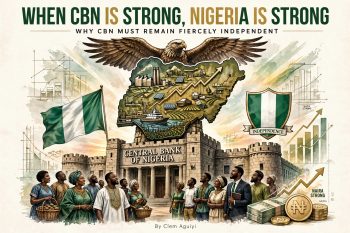
Every nation has an institution that determines whether it rises or falls, and for Nigeria that institution is the Central Bank of Nigeria. If Nigeria is to have a promising and brighter 2027, the CBN must be at the centre of it, not at the margin, not as an afterthought, but as the anchor of stability, the guardian of value, and the engine of confidence. Everything else depends on money. You cannot build roads without money, you cannot pay salaries without money, you cannot grow businesses without money, and you cannot fight poverty without money. And the value, the cost, and the availability of that money is determined by the Central Bank. A nation can have good intentions, but if its central bank is weak, those intentions will collapse. A nation can have great policies, but if its currency is unstable, those policies will fail. That is why 2027 will be won or lost at the CBN. When the CBN is strong, Nigeria is strong. When the CBN is weak, Nigeria is weak. When the CBN is politicized, Nigeria is poisoned. The CBN is not just another agency of government. It is the heart of the economy. It controls the value of the naira in your pocket, the price of money, inflation, interest rates, and the confidence of the world in Nigeria. If you tamper with that heart, you tamper with the life of the nation. That is why the CBN must remain fiercely independent, not partially independent, not independent when it is convenient, but fiercely independent. Independence does not mean the CBN is above the law. It does not mean the Governor is above the President. It means monetary policy must be based on data, not on politics, on economics, not on elections, on the long-term interest of Nigeria, not on the short-term interest of any government. It means the CBN must be free to raise interest rates when inflation is high even if politicians want cheap money for elections, free to say no to printing money to fund deficits even if the Ministry of Finance is under pressure, and free to unify the exchange rate even if a few powerful people are benefiting from multiple rates. An independent CBN is a CBN that can look a President in the eye and say that a policy will destroy the naira and will not be done.
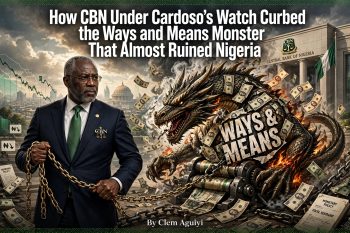
We have seen what happens when the CBN is weak, and we lived it. For years the CBN became an extension of the Presidency. Ways and Means, the printing of money to fund government spending, rose to over N30 trillion. That was not monetary policy, that was monetary madness. When you print N30 trillion without production, you do not create wealth, you create inflation, you make the naira worthless. We operated multiple exchange rates. One rate for the connected, another rate for the rest of us. The connected bought dollars at N460 and sold at N750. They became billionaires without building a single factory, while real manufacturers could not get dollars to import raw materials, students abroad could not pay school fees, and airlines could not repatriate their earnings. The multiple rate system did not protect the naira, it destroyed trust in the naira. It did not allocate dollars fairly, it allocated dollars to the powerful. We had intervention programmes that were more political than economic, billions disbursed in the name of Anchor Borrowers, SMEs, and agriculture, but with little accountability, many saw it as national cake and never repaid. And we had the naira redesign of 2023, a policy implemented without cash, without preparation, without empathy. Nigerians slept at ATMs, businesses collapsed, the poor suffered most. A strong, independent CBN would have demanded proper planning, proper timing, and proper consultation. A weak CBN simply obeyed. The lesson is clear, a CBN that cannot say no will always say yes to disaster. To serve politics means to print money to fund elections, to keep interest rates low before an election even when inflation is killing the poor, to give dollars cheap to friends of government while manufacturers and students suffer, and to launch programmes meant to buy loyalty rather than to be repaid. When the CBN serves politics, the rich get richer and the poor get poorer.
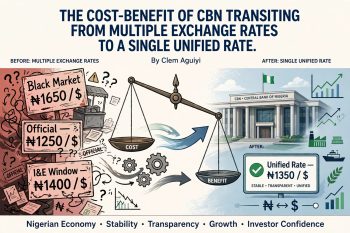
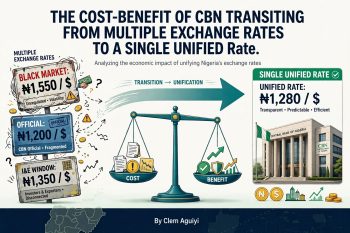
Today, the story is changing. Under Governor Olayemi Cardoso, the CBN is rediscovering its independence and its courage. It unified the exchange rate. It stopped Ways and Means abuse. It cleared the 7 billion dollars FX backlog. It began recapitalising banks to make them stronger. It raised interest rates to fight inflation even when it was unpopular. These were not popular decisions, they were painful decisions, but they were correct decisions, and they were only possible because the CBN is being allowed to do its job. Unification was painful, the naira moved from N460 to over N750 overnight, inflation rose to over 30 percent, and millions felt it in their pockets and kitchens. But the alternative was to continue the lie. The benefit is far higher. Arbitrage is dead, there is no longer a cheap window and an expensive window. Investor confidence is returning because no serious investor invests in a country with five exchange rates. Dollars now go to who can pay the market price, not to who you know. Reserves are now managed transparently, and a realistic naira makes Nigerian exports cheaper and local production more competitive. If we had continued with multiple rates, we would have continued to lose reserves, continued to lose investors, continued to breed corruption, and eventually faced a full currency collapse. The cost of not reforming would have been far greater than the cost of reforming. The same discipline must now be applied to our physical currency. Nigeria cannot run a modern economy on confusion, yet today we have old naira notes and new naira notes circulating side by side, with different designs for the same denomination. Traders reject one design, banks sort another, and counterfeiters exploit the confusion. A currency must be a medium of exchange, a store of value, and a unit of account. Our dual design fails all three. The CBN must end this era, not with panic and punishment as in 2023, but with planning, with 12 months notice, with enough new notes in circulation, with nationwide education in English, Igbo, Yoruba, Hausa and Pidgin, with mobile swap agents for rural areas, and with a final grace window at CBN branches for the elderly and those who genuinely missed the deadline. At the same time, it must push digital payments so that a market woman can receive money on her phone without stress.
Some people think CBN independence is a matter for economists and bankers. They are wrong. It is a matter for market women, farmers, students, and artisans. When the CBN is independent and fights inflation, the price of garri, rice, and yam is protected. Inflation is the cruelest tax on the poor. The rich can buy dollars and land, the poor cannot. When the CBN is independent and keeps the exchange rate stable, the trader in Onitsha can plan his imports, the manufacturer in Nnewi can price his goods, and the student abroad can pay school fees without panic. When the CBN is independent and regulates banks properly, your savings are safe. The poor is the market woman who watches her capital disappear because transport doubles every month, the farmer who cannot get fertilizer because the naira has collapsed, the graduate who cannot start a workshop because banks will not lend to him, the mother who goes to market with N10,000 and comes back with half of what she bought last month. These are the people the CBN must serve. It must make credit accessible to MSMEs, drive financial inclusion so that a woman in a village can open an account with her phone, save safely, and borrow at a fair rate, and protect depositors through strict regulation. Look around the world, every successful economy has an independent central bank. The US Federal Reserve raises rates even when the President complains, the Bank of England refuses to print money to fund government. No country became great by using its central bank as a political ATM. Every country that tried it, Zimbabwe, Venezuela, Argentina in its worst years, paid a terrible price. As we head to 2027, the temptation to politicize the CBN will grow. Politicians will want cheap money, low rates before elections, and the CBN to fund their promises. We must resist. The National Assembly must strengthen the CBN Act, the Presidency must respect its autonomy even when it is inconvenient, and Nigerians must defend it when politicians try to bully it. Let the CBN do its work. Let it fight inflation without fear, regulate banks without favour, and protect the naira without interference. Because when the CBN serves the poor, the naira is stable, businesses grow, jobs are created, poverty falls, and Nigeria rises. A CBN that serves the poor is a CBN that serves Nigeria, and a Nigeria that serves its poor is a Nigeria headed for a promising and brighter 2027.





Leave a Reply