

Tel: 08034747898
For years, Nigeria lived a lie. We pretended we had one naira, but we had many nairas. One for the government, one for the connected, one for manufacturers, one for students, and one for the rest of us on the street.
That lie was called the multiple exchange rate regime. And its end – the transition to a single, unified exchange rate – is one of the most important, most painful, and most beneficial reforms in Nigeria’s economic history.
To judge it fairly, we must weigh its costs and its benefits. Not with emotion, but with reason.
*What Was The Multiple Rate System?*
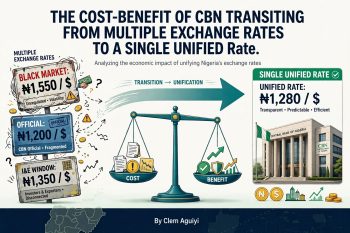
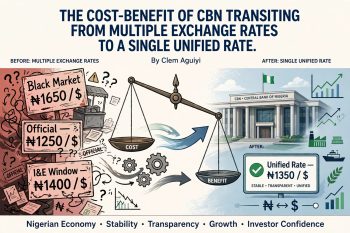
Under the old system, the CBN maintained different windows: the official window, the Investors and Exporters window, the SME window, the BTA/PTA window, and the parallel market.
The official rate was often N460 to a dollar. The parallel market was N750, sometimes N900. The gap was not small. It was a canyon.
In theory, the system was meant to protect the naira and allocate scarce dollars to priority sectors. In practice, it became a machine for corruption.
If you were connected, you got dollars at N460 from the CBN. You sold at N750 on the street. You made N290 on every dollar without producing anything, without employing anyone, without creating any value. It was the easiest business in Nigeria: round-tripping.
If you were not connected – a real manufacturer in Nnewi, a real importer in Lagos, a real student in London – you could not get dollars at the official rate. You were forced to the black market, where you paid the full price.
The multiple rate system did not protect the naira. It destroyed trust in the naira. It did not allocate dollars fairly. It allocated dollars to the powerful.
*The Cost of Transition*
Let us be honest: Unification was painful. No reform of this magnitude is painless.
*1. Immediate Devaluation:* When the rates were unified in June 2023, the naira moved from N460 to over N750 overnight. For importers, the cost of goods doubled. For manufacturers, the cost of raw materials exploded. For ordinary Nigerians, the price of everything – fuel, food, medicine, school fees – went up.
*2. Inflation Shock:* Unification fed directly into inflation. Because Nigeria imports much of what it consumes, a weaker naira meant higher import prices. Inflation, already high, rose to over 30%. The poor suffered most.
*3. Debt Burden:* Nigeria’s dollar-denominated debt became more expensive in naira terms. Government needed more naira to service the same dollar debt.
*4. Business Disruption:* Many businesses that had built their models on cheap official dollars collapsed. They could not survive at the true market rate. Jobs were lost. Companies closed.
These costs were real. They were not imagined. Millions of Nigerians felt them in their pockets, in their kitchens, in their businesses.
Any honest defender of unification must admit this: The transition hurt.
*The Benefit of Transition*
But what is the alternative? To continue the lie? To continue subsidizing a few at the expense of the many? Let us count the benefits.
*1. End of Round-Tripping and Corruption:* The single biggest benefit is that arbitrage is dead. There is no longer a cheap window and an expensive window. You cannot buy at N460 and sell at N750, because there is only one rate. The billionaires who made money from doing nothing have lost their free lunch. That money now stays in the economy.
*2. Restoration of Investor Confidence:* No serious investor invests in a country with five exchange rates. How do you plan? How do you repatriate profit? How do you know the true value of your investment? Unification gave the world one truth. And the world is responding. Foreign portfolio investment is returning. Foreign direct investment is looking again. The $7 billion FX backlog was cleared because investors now trust that they will get their money at a real rate.
*3. Fair Allocation of Dollars:* Under the old system, dollars went to who you knew. Under the unified system, dollars go to who can pay the market price. It is not perfect, but it is fairer. A manufacturer and a speculator now compete on equal terms. The market, not connections, decides.
*4. Improved Reserves and Transparency:* The CBN no longer burns reserves defending an artificial rate. Reserves are now managed transparently. The naira is finding its true level based on supply and demand, not on political decree. That is how a modern economy works.
*5. Boost to Exports and Local Production:* A realistic naira makes Nigerian exports cheaper and more competitive abroad. It makes imports more expensive, which encourages local production. A manufacturer in Aba now has a better chance to compete with imported goods, because imports are no longer subsidized by a fake exchange rate. In the long run, this is how we build a productive economy.
*6. Fiscal Discipline:* Unification forced government to face reality. It can no longer hide the true cost of subsidies and imports. It must earn dollars through exports, through investment, through productivity – not through manipulation.
*Cost vs. Benefit: The Verdict*
So, was it worth it?
In the short term, the cost was high. Inflation rose. The naira fell. The poor suffered. We must never minimize that pain.
But in the long term, the benefit is far higher. The multiple rate system was a slow poison. It was killing trust, killing investment, killing production, and enriching a few. Unification was bitter medicine. It tasted bad, but it cured the disease.
Think of it this way: The multiple rate system was like keeping a wound covered with a dirty bandage. It looked fine from outside, but inside it was rotting. Unification removed the bandage, cleaned the wound, and allowed it to heal. Yes, it hurt. But healing requires pain.
If we had continued with multiple rates, we would have continued to lose reserves, continued to lose investors, continued to breed corruption, and eventually faced a full currency collapse. The cost of not reforming would have been far greater than the cost of reforming.
*What Must Happen Next?*
Unification alone is not enough. To make the benefits permanent, the CBN must: Protect the unified rate and never return to multiple windows. Deepen the forex market so supply meets demand. Increase dollar supply through exports, remittances, and investment, not through borrowing. Support local production so Nigeria earns more than it spends. And above all, communicate clearly so Nigerians understand why reform is necessary.
*Conclusion*
The transition from multiple exchange rates to a single unified rate was painful, but it was necessary. It was costly, but it was beneficial. It was the end of a lie and the beginning of truth.
Nigeria cannot build a prosperous economy on a fake exchange rate. We cannot build investor confidence on manipulation. We cannot build a future on corruption.
The single rate is honest. It is transparent. It is fair. And honesty, in the long run, is always cheaper than lies.
The cost was yesterday’s pain. The benefit is tomorrow’s promise – a stable naira, a trusted economy, and a brighter 2027.









Leave a Reply