

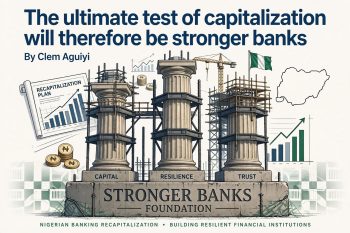
The ultimate test of capitalization will therefore be whether stronger banks translate their improved capacity into productive lending, business expansion and job creation.
- Supporting Banking Stability During Difficult Economic Reforms
Nigeria’s recent economic reforms have involved difficult adjustments, including changes to foreign exchange arrangements, tighter monetary policy and efforts to address longstanding fiscal and financial imbalances.
Such measures can place pressure on banks.
Currency depreciation can affect the value of foreign-currency assets and liabilities. Higher interest rates can increase borrowing costs and expose weaknesses among indebted customers. Inflation can erode household purchasing power and make business planning more difficult.
In this environment, adequately capitalised banks are particularly important.
Capital serves as a financial cushion, helping institutions absorb losses without immediately threatening depositors or the wider financial system.
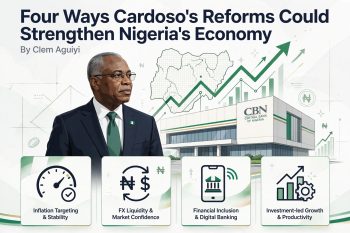
The argument in favour of Cardoso’s strategy is that strengthening banks alongside broader monetary reforms could help Nigeria manage economic adjustment with less risk of banking-sector instability.
This is an important lesson in economic policymaking: reforms must not only address immediate problems but also strengthen the institutions expected to withstand their consequences.
Nevertheless, claims that no bank has failed, no depositor has lost money or that the banking system has remained entirely unaffected should be assessed against official regulatory records and independently verified evidence.
The objective should be to celebrate measurable progress without overlooking the need for continued vigilance.
- Building a Foundation for Nigeria’s Long-Term Growth
A strong banking sector can help determine whether Nigeria’s economic potential becomes a reality.
The CBN’s foreign exchange reforms, efforts to improve market transparency and measures to strengthen external reserves form part of a broader economic policy debate.
One initiative highlighted in discussions of foreign exchange reform is the Electronic Foreign Exchange Matching System, designed to support more transparent and orderly transactions in the official market.
Greater transparency can help reduce uncertainty, improve price discovery and encourage legitimate foreign exchange transactions.
Similarly, stronger external reserves can improve a country’s capacity to meet international payment obligations and respond to external shocks.
The figures cited in this article—including external reserves of $55.25 billion as of September 2026, inflation of 15.39 per cent and capital importation of $20.98 billion in 2025—should be checked against the relevant CBN, National Bureau of Statistics and National Bureau of Statistics capital-importation reports before publication.
If verified, such indicators would help readers assess the broader economic environment in which the banking reforms are taking place.
But the ultimate objective is not simply to improve financial statistics. It is to create conditions in which businesses can invest confidently, households can plan for the future and productive sectors can expand.
Looking Ahead: What Could Stronger Banks Mean for Nigeria?
Imagine Nigeria in 2028.
Imagine well-capitalised banks working together to finance major transport infrastructure, modern agricultural enterprises, renewable energy projects and industrial development.
Imagine a Nigerian farmer gaining access to financing for irrigation, mechanisation, improved seeds and storage facilities.
Imagine a manufacturer expanding production instead of spending years struggling to obtain working capital.
Imagine a young professional gaining access to a mortgage product with reasonable terms, supported by a more stable financial system and a housing market capable of serving ordinary Nigerians.
These possibilities are not guaranteed outcomes of recapitalisation. They depend on sound economic management, effective regulation, responsible lending, improved infrastructure and a business environment that rewards productive investment.
Yet a stronger banking system can provide an essential foundation on which such progress becomes more achievable.
That is why the recapitalisation programme deserves serious attention. Its significance lies not merely in the amount of capital raised, but in the opportunities that stronger financial institutions could help unlock.
Leadership, Courage and the Discipline of Reform
Economic reform is rarely popular at the beginning.
Changes to established practices often generate resistance, particularly when they require institutions to adjust their business models, raise additional capital or accept greater regulatory scrutiny.
Leadership in such circumstances requires more than announcing ambitious targets. It demands consistency, communication, professional competence and a willingness to enforce rules fairly.
Cardoso’s supporters see the recapitalisation programme as evidence of a determination to strengthen Nigeria’s financial architecture rather than preserve the status quo.
They argue that the country needs a banking sector capable of supporting its ambitions, not one constrained by capital limitations and uncertainty.
For the programme to become a lasting success, however, the CBN must continue to protect competition, promote sound governance and ensure that the benefits of a stronger banking system reach businesses and households across the country.
Reform must be judged by its outcomes, not simply by the boldness of its announcement.
Conclusion: Restoring Confidence, Strengthening the Future
Olayemi Cardoso’s banking recapitalisation initiative represents an important chapter in Nigeria’s ongoing effort to strengthen its financial system.
Its central message is compelling: a country that seeks sustainable economic growth must build strong financial institutions capable of supporting investment, absorbing shocks and maintaining public confidence.
Stronger banks can create opportunities for larger infrastructure projects, more productive businesses and improved access to finance. Combined with sound monetary policy, responsible supervision and broader economic reforms, recapitalisation can contribute to a more resilient financial system.
But the work does not end when banks meet their capital requirements. The real measure of success will be seen in the strength of businesses, the creation of jobs, the stability of financial institutions and the availability of responsible credit to productive sectors.
Cardoso’s legacy will ultimately depend on whether the reforms produce those lasting benefits.
Nigeria does not merely need bigger banks. It needs banks that are safer, more transparent, more competitive and more responsive to the needs of its people.
Because when the heart of an economy is strong, the entire nation has a better chance of thriving.
Clem Aguiyi
Writer and Commentator on Economic and National Development
Contact: 08034747898










Leave a Reply