

Tel: 08034747898
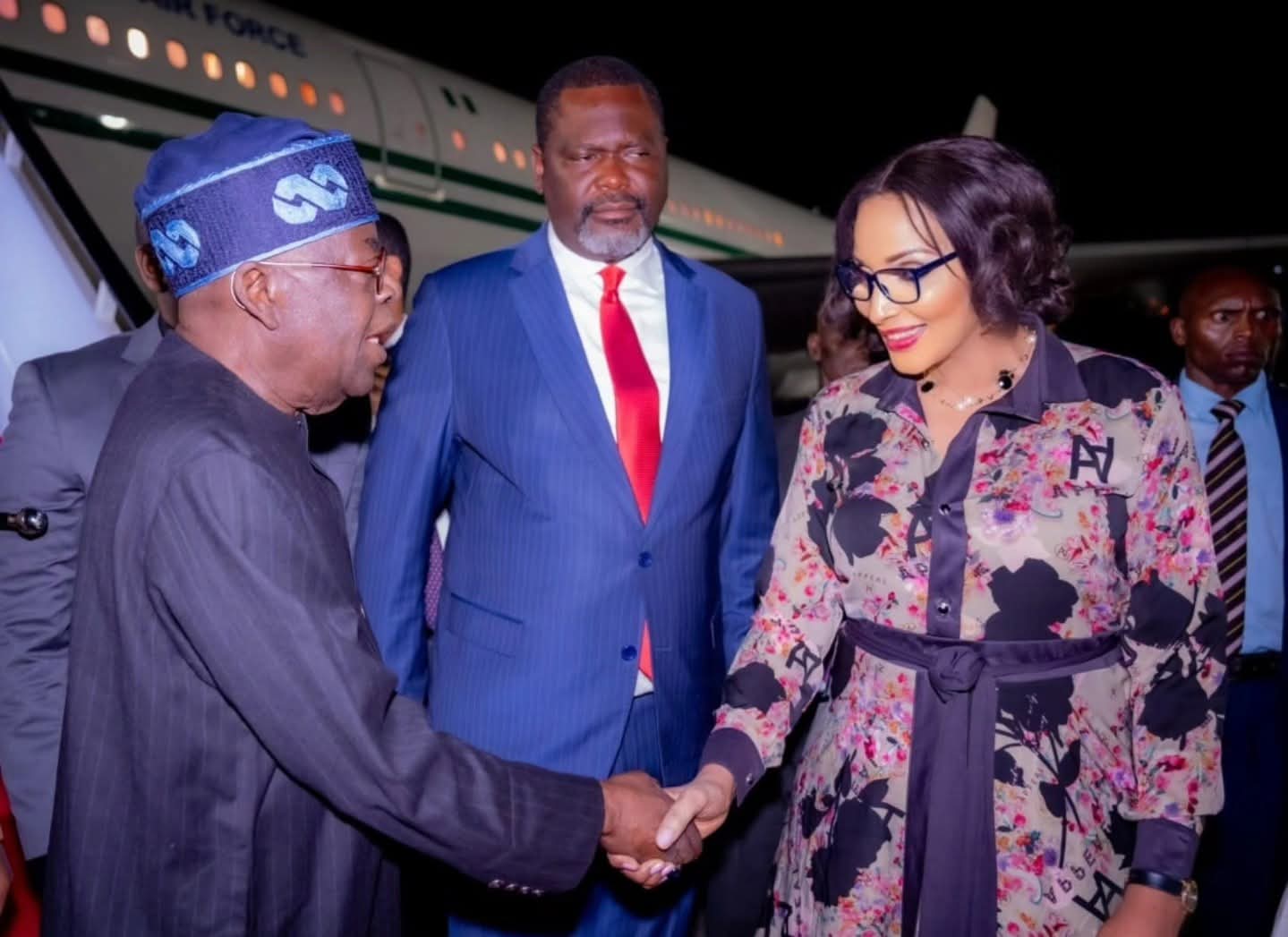
For decades, if you asked a Nigerian to name the Minister of Foreign Affairs, you’d likely get a shrug. The office existed, but it rarely registered. It was a revolving door of technocrats and political loyalists who managed protocol, attended summits, shook hands, and faded back into obscurity. The work was done, but the impact was invisible. That changed when President Bola Ahmed Tinubu elevated Bianca Odumegwu-Ojukwu to full Minister of Foreign Affairs, because in one move he took the widow of Nigeria’s most famous secessionist and placed her at the center of the country’s diplomatic outreach.
The symbolism is impossible to miss. Bianca Onoh was a beauty queen, a lawyer, an international relations expert with a presence that made her recognizable long before politics. But her name became permanently tied to Nigeria’s most painful fault line when she married Chukwuemeka Odumegwu Ojukwu in 1994. Ojukwu led the Biafran secession between 1967 and 1970, a war that killed over a million Nigerians and left a scar that still shapes how the Southeast sees itself within the federation. For some he is a hero who stood up to federal marginalization. For others he is the man who pushed the country into its bloodiest conflict. Either way, he is history you cannot ignore.
After years in exile, Ojukwu returned under Shagari’s amnesty and spent the rest of his life advocating for Igbo reintegration and national unity. Bianca walked that same path. She served as Nigeria’s ambassador to Spain and Ghana, building a reputation as someone who could speak for Nigeria without pretending the Southeast’s grievances didn’t exist. When Tinubu appointed her Minister of State for Foreign Affairs in 2024, it was already significant. When Yusuf Tuggar resigned in 2026 to pursue the Bauchi governorship, Tinubu elevated her to full cabinet rank. The message was immediate: the president isn’t afraid of history, he’s using it. Putting Bianca in charge of foreign affairs tells the Southeast that their story is part of Nigeria’s story. It tells the international community that Nigeria can handle its contradictions without erasing them. And it tells political opponents that Tinubu is willing to make appointments that transcend party lines and old grudges.
This is the same kind of political jiu-jitsu that made Marco Rubio go from calling Donald Trump a fraud on the debate stage in 2016 to becoming Secretary of State and National Security Adviser in 2025, a dual role that has him outpacing even Henry Kissinger in influence. Trump took his fiercest critic and made him part of the machine. The criticism was neutralized and converted into credibility. When Rubio speaks now, it’s harder to dismiss him as a partisan hack because he’s inside the room. Tinubu faced a parallel situation. The Southeast has been politically estranged from the center since 2015, and every federal appointment in that region gets read through the lens of tokenism or appeasement. The Ojukwu legacy is the sharpest symbol of that estrangement. By appointing Bianca, Tinubu changed the frame of the conversation from us versus them to this is our shared foreign policy. It’s harder for separatist agitators to claim that Abuja ignores the Southeast when the person leading Nigeria’s foreign policy is married to the man who once led Biafra.
The impact goes beyond symbolism because Bianca understands both the room and the rooms that matter. Foreign policy fails when the person in charge doesn’t understand what Nigeria needs and what the other side thinks they’re hearing. Her background gives her both. As a lawyer and IR expert, she understands treaty language, diplomatic protocol, and the mechanics of bilateral negotiation. As a former beauty queen and public figure, she understands narrative and perception. And as Ojukwu’s widow, she understands the emotional undercurrent of Igbo politics and how it plays abroad. That mix matters because Nigeria’s foreign policy problem has never been a lack of resources. It has been a lack of clarity and presence.
For fifty years Nigeria was the giant of Africa that rarely showed up to claim the title. At ECOWAS, at the African Union, at the United Nations, we had size but not voice. Our ambassadors were competent, but they weren’t memorable. Our foreign policy was reactive, responding to crises in Niger, Mali, and Ghana, without setting the agenda. Bianca changed that posture. Her speeches at the UN General Assembly and AU summits stopped being procedural read-outs and became statements of doctrine. She frames Nigeria as a stabilizing force in West Africa, a defender of constitutional order, and a country ready to lead on energy transition and regional trade. She’s comfortable speaking to Davos investors in the morning and diaspora town halls in Houston at night. That range lets her carry two messages at once: Nigeria is open for business, and Nigeria is serious about its internal cohesion.
What she’s doing differently comes down to three shifts. First, she moved from protocol to doctrine. Previous ministers focused on managing bilateral relationships and keeping the calendar full. Bianca is pushing a doctrine of African Solutions, African Stability, African Markets. Nigeria will lead mediation in West Africa, but only if ECOWAS states commit to constitutional governance. That’s why Nigeria took a hard line on the Niger coup in 2023 and 2024, even when it was diplomatically costly. The message was that consistency matters more than convenience.
Second, she treated the diaspora as an asset, not an afterthought. Town halls in London, Johannesburg, and Houston aren’t photo ops anymore. They’re feedback loops for trade policy, investment guarantees, and consular reform. The Nigerian diaspora sends over twenty billion dollars home annually. For too long that money flowed in while policy decisions flowed out without their input. Bianca made them stakeholders, and when the diaspora feels seen, Nigeria’s reputation abroad improves because the people who actually live abroad become the country’s most credible ambassadors.
Third, she linked domestic reintegration to foreign credibility. In Geneva and Addis Ababa, she tells the story of post-war reintegration after 1970 as evidence that Nigeria can manage diversity and come back stronger. It’s personal, and it resonates with countries dealing with their own ethnic and regional fractures. By framing internal cohesion as a precondition for regional leadership, she gives Nigeria’s foreign policy a moral and practical foundation that audiences outside the country understand.
None of this happened by accident. Tinubu reads people like a chess player reads a board. He knows that in Nigerian politics, symbolic appointments often carry more weight than policy briefs. Appointing Bianca cost him nothing with his Southwest base and bought him credibility in the Southeast and internationally. He started her as Minister of State, gave her time to learn the bureaucracy, and let her prove herself on lower-stakes briefs. When Tuggar left, the elevation looked like merit, not a stunt. And crucially, he gave her space to operate. A common mistake in Abuja is appointing high-profile figures and then micromanaging them into irrelevance. Tinubu let her run, and the result is a foreign ministry that feels proactive for the first time in decades.
Of course, no move this bold is without risk. The first risk is that domestic policy doesn’t match the foreign policy rhetoric. You can’t sell Nigeria as a stable regional leader if insecurity and inflation at home contradict the message. Bianca can open doors, but Tinubu’s economic team has to walk through them. The second risk is that the appointment gets read as a one-off. One Igbo minister doesn’t erase decades of political alienation. The test is whether this becomes part of a broader pattern of integration, not an isolated gesture. The third risk is bureaucratic resistance. The Ministry of Foreign Affairs has a career diplomatic corps used to low visibility and low expectation. A high-profile, high-expectation minister creates friction. Managing that internally is as important as managing Nigeria’s image abroad.
Beyond Nigeria, the move matters because Africa’s problem isn’t lack of talent. It’s lack of narrative control. Too often, our foreign policy is written for us in London, Paris, Washington, and Beijing. What Tinubu and Bianca are doing is reclaiming the narrative. They’re saying that Nigeria’s history, including its painful parts, is a source of diplomatic leverage, not embarrassment. That’s a lesson for other African states dealing with post-conflict identities and regional leadership ambitions. If you can’t speak honestly about where you’ve been, you can’t persuade anyone about where you’re going.
For the rest of the world, it’s a reminder that effective foreign policy starts with understanding your own contradictions. You can’t project strength abroad if you’re still fighting the civil war at home. By putting Bianca in that seat, Tinubu acknowledged the civil war without reliving it. He turned a historical wound into a diplomatic asset. That’s rare in any political system, and it’s especially rare in a country where history is usually used as a weapon rather than a bridge.
Most Nigerian presidents play chequers. Move a piece, capture a piece, repeat. Tinubu is playing chess. Appointing Bianca Ojukwu doesn’t guarantee Igbo votes in 2027, and it doesn’t erase the memory of Biafra. But it changes the cost calculation for anyone who wants to run an anti-Nigeria narrative abroad. It gives Nigeria a foreign minister who can speak to Washington, Brussels, and Enugu in the same week without sounding like she’s reading two different scripts.
That’s why, for the first time in fifty years, people outside the foreign service know the name of Nigeria’s Foreign Minister. That’s why her speeches get quoted in Addis Ababa and Geneva. That’s why Nigerian greatness is starting to sound less like nostalgia and more like a plan. The question now is whether the rest of the government can match that clarity of purpose. If the economic and security teams can align with the diplomatic opening she’s created, Nigeria’s influence won’t just be back in speeches. It’ll be back in practice, in trade deals signed, in conflicts mediated, in investments unlocked.
History gave Tinubu a critic with a name the world recognizes. He didn’t neutralize her by sidelining her. He made her indispensable. And in doing so, he reminded everyone watching that in politics, the sharpest weapon is often the person you were supposed to be fighting.
Tinubu’s Chess Move: How He Turned Ojukwu’s Widow into Nigeria’s Foreign Policy Weapon. By Clem Aguiyi





Leave a Reply