

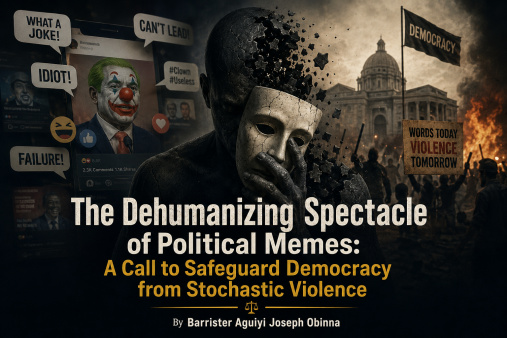
In the theater of Nigerian politics, where the stakes of leadership are nothing less than the soul of our nation, a disturbing trend has emerged that threatens to unravel the fragile fabric of our democracy. The recent irresponsible graphical stochastic violence directed at His Excellency Peter Obi, the Labour Party’s presidential candidate, exemplifies this peril. Posted by Daniel Bwala, a spokesperson for the All Progressives Congress (APC), the puerile meme employs violent imagery—placing Obi in symbolic objects like coffins or mouse traps—to dehumanize him, portraying the NDC candidate as an undesirable element unworthy of political participation, indeed someone who “ought to be shot.” This act of ironic violence did not occur in isolation. It followed swiftly on the heels of Peter Obi’s public complaint about threats to his life, turning a moment of legitimate security concern into a sickening escalation.
What do we call such politics of posting weird graphical depictions of opponents in coffins, mouse traps, or crosshairs? As aptly analyzed, it constitutes *dehumanizing political symbolism* or *violent political imagery*—a form of *meme warfare* and *stochastic rhetoric*. These are not harmless jokes or innocent trolls. By design, they offer plausible deniability (“I was just trolling”) while embedding a clear message: the target is a pest to be eliminated, a threat whose right to exist in the political space should be terminated. The symbolism is unmistakable—coffin implies death, mouse trap equates the opponent to vermin deserving extermination, and crosshairs suggest they should be shot. This is *ironic violence*: hostility wrapped in humor to spread rapidly and evade accountability.
Such conduct is neither healthy nor productive. Genuine political debate argues policy, records, and ideas; it persuades through reason and invites compromise. Violent memes, by contrast, attack the person’s very legitimacy. They replace substantive engagement with personal demonization, triggering anger, fear, and disgust. They foster “us versus them” tribalism rather than national progress. In Obi’s case, the meme came at a time when the nation watched with trepidation as threats loomed. Far from the measured approach of the Minister of Aviation, whose responses have maintained a semblance of decorum, Bwala’s overzealous criminal intent amplified the spectacle to a dangerous level. This overreach signals a descent into base instincts unworthy of public office.
The psychological state of perpetrators like Bwala reveals strategic cynicism rather than mere impulsivity. Driven by outrage marketing for engagement, in-group bonding, and narcissistic dominance, such actors desensitize themselves and their audience to the humanity of opponents. Empathy erodes; opponents cease to be fellow citizens and become “evil” obstacles to be removed. Research on these dynamics shows clear pathways to harm: normalization (violence feels ordinary), permission (followers interpret it as official tolerance), and dehumanization (the psychological prelude to actual aggression, seen historically in riots and worse).
This behavior is profoundly dangerous and risks snowballing into actual violence that could overwhelm our security apparatus during the election season. When government-aligned figures publicly traffic in eliminationist imagery, it lowers the threshold for real-world action. Supporters, already polarized, may feel emboldened to translate memes into threats or physical attacks. In a nation grappling with insecurity, such rhetoric distracts from policy, erodes public trust, and turns institutions into battlegrounds. The public loses meaningful debate; the target faces heightened safety risks; and even the perpetrator risks long-term backlash when the same tactics boomerang. People in government bear a higher responsibility—they wield state power, influence security forces, and set the national tone. Their indulgence in dirty politics signals endorsement, making restraint by ordinary citizens harder to demand.
Every reasonable Nigerian must demand accountability. President Bola Tinubu should immediately withdraw the services of this infantile urchin and “magadog” called Daniel Bwala. Presidential silence on this matter may be interpreted as tacit approval of insults, threats, and the pathway to violence. The Nigeria Bar Association must rise to the occasion and consider debarring such actors, marking clear no-go areas for legal practitioners who undermine democracy and the rule of law. The Department of State Services (DSS) and the Nigeria Police Force must promptly call Bwala to order and ensure he faces appropriate punishment. These steps are essential to enforcing compliance with democratic norms and preventing escalation.
The broader implications are dire. If left unchecked, this trend will normalize stochastic violence, where indirect cues incite unpredictable harm. It distracts from pressing national issues—economy, security, governance—and poisons the electoral environment. Healthy politics builds; this destroys. As the provided analysis underscores, such symbolism gains short-term attention for the poster and mobilizes extremes but causes long-term losses for the polity: eroded trust, heightened hostility, and weakened institutions.
Nigeria stands at a crossroads. We must discourage this dehumanizing symbolism through ethical codes, public condemnation, and institutional action. Leaders should model restraint, not vicious dominance. Peter Obi’s resilience in the face of such attacks reminds us that ideas and service, not eliminationist fantasies, should define our politics. Let us reject the politics that argues a person “shouldn’t exist” and embrace one that debates what they can do for our collective future. The rule of law, democratic health, and national stability demand nothing less.
The Dehumanizing Spectacle of Political Memes: A Call to Safeguard Democracy from Stochastic Violence By Barrister Aguiyi Joseph Obinna




Leave a Reply