

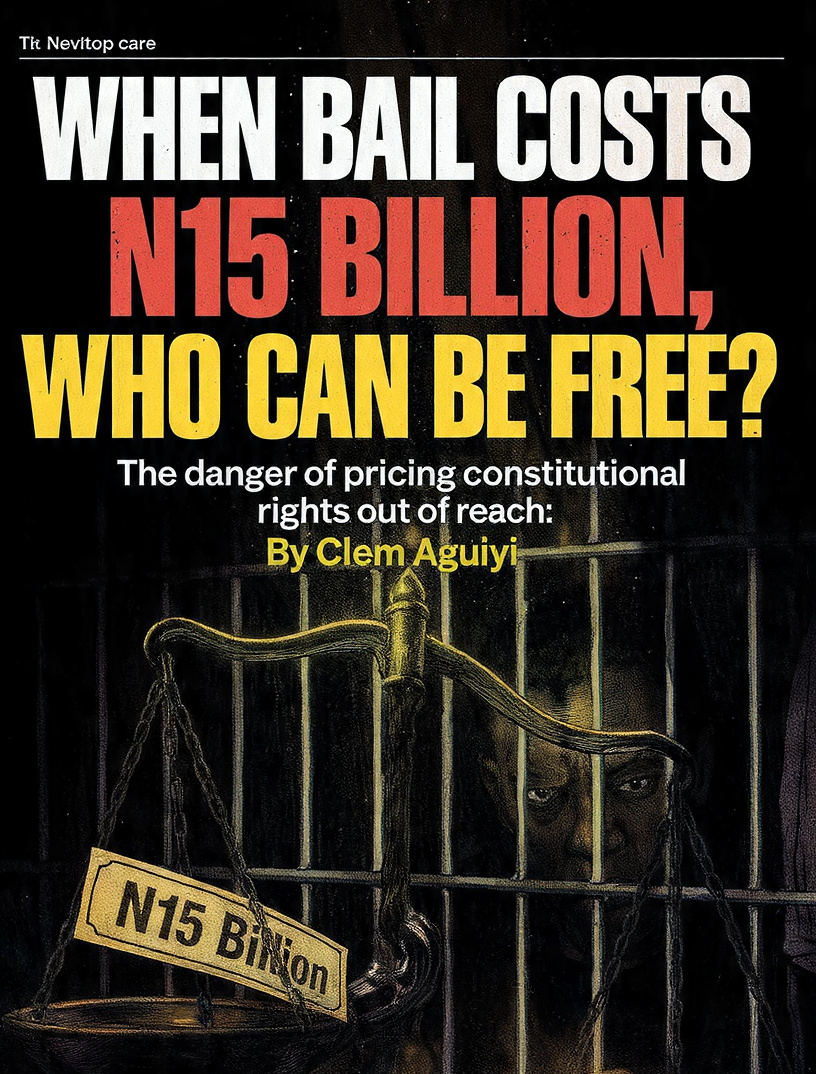
In a recent ruling by an Abuja High Court, a defendant in a high-profile corruption case was granted bail. The prosecution, according to the court, offered no compelling reason to deny bail. That part of the decision aligns with the law. The presumption of innocence under Section 36(5) of the 1999 Constitution is not a slogan. It is a command. Until a court proves guilt beyond reasonable doubt, every accused person remains innocent in the eyes of the law.
But then came the conditions. Sureties must be serving federal civil servants of Grade Level 17 and above. Each surety must own a property in Abuja worth ₦500 million. One must provide a bank guarantee of ₦15 billion. The passport of the accused was also to be deposited.
The question is not whether courts have discretion. They do. Section 165(1) of the Administration of Criminal Justice Act, ACJA 2015, gives judges power to impose bail terms “with due regard to the circumstances of the case and shall not be excessive.” The question is whether those conditions respect that limit, or whether they cross the line from securing attendance to denying liberty by arithmetic.
Let us take the numbers seriously, because numbers reveal intent. A federal civil servant who enters service at Grade Level 8 and rises steadily over 28 years to Grade Level 17 will earn, over his entire career, between ₦80 million and ₦100 million before tax, rent, school fees, healthcare, and other living costs. Out of that comes the mortgage on a family home, transport, and the daily burdens of life.
The court now asks such an officer to show proof of a property worth ₦500 million, five times his lifetime earnings. It also asks him to stand behind a bank guarantee of ₦15 billion, roughly 150 times what an honest career in public service can yield.
What message does that send to millions of Nigerians who serve the state faithfully? It says, in plain terms, that lawful public service cannot produce the kind of wealth the court now expects of a “respectable” citizen. It suggests that the only civil servant worth trusting as surety is the one whose assets cannot be explained by salary alone. In an anti-corruption trial, that is a dangerous proxy for integrity. It rewards unexplained wealth and punishes transparency.
The passport condition adds another layer of concern. Senior officers travel on official business: trade negotiations, training, regional meetings, diplomatic assignments. Depriving them of passports to vouch for an accused person interferes with duties the government itself assigns them. The state cannot, in one breath, demand their service and, in another, cripple their capacity to perform it.
To grasp the scale, imagine a court in London demanding that a British civil servant own property in Belgravia, Chelsea, or Mayfair before standing surety, and produce a bank guarantee of £8.2 million, the naira equivalent of ₦15 billion. The debate about proportionality and fairness would be immediate. Nigeria deserves the same standard of reasonableness.
Courts are not without guidance. Section 165(1) of ACJA 2015 is deliberate. It says bail conditions must reflect the facts of each case and must not be excessive. Excessive does not mean “high.” It means disproportionate to the risk the court seeks to manage. If there is no credible evidence of flight risk, then conditions fit for a fugitive with hidden billions become legally incoherent.
The Court of Appeal has spoken directly on this issue. In _Dasuki v. D.G., SSS_ (2019), the court struck down bail terms that required serving public servants as sureties and imposed a ₦100 million bond. The judgment was clear: such requirements are unknown to our law, conflict with Public Service Rules, and damage the fight against corruption by exposing honest officers to liabilities their salaries cannot justify.
Today, we have moved from ₦100 million to ₦500 million in property value, and from a bond to a ₦15 billion bank guarantee. If the Court of Appeal found ₦100 million excessive in a case involving national security, caution demands we ask whether ₦15 billion is consistent with the principle of proportionality.
The purpose of bail is not punishment. It is process. Section 36(5) of the Constitution presumes innocence. Section 35 guarantees personal liberty. Bail exists to balance that liberty with the state’s interest in securing the accused’s presence at trial. When conditions become so high that only a fraction of Nigerians can meet them, bail stops being a safeguard and becomes pretrial detention under another name.
It is fair to acknowledge the court’s dilemma. High-profile corruption cases involve large sums, powerful networks, and real incentives to evade trial. Judges must protect the integrity of proceedings. They must prevent witness interference and ensure defendants appear. Discretion exists for that reason.
But discretion must be guided by reasonableness. A court that finds no real risk of flight cannot, in the same judgment, impose conditions designed for a fugitive of extraordinary means. That is a contradiction. If the evidence shows flight risk, deny bail outright and give reasons. If the evidence does not, then set conditions that are verifiable, tailored, and capable of being met.
Section 168 of ACJA provides for variation of bail precisely because courts recognize that conditions can miss the mark. An accused person can return to the same court with new evidence of inability to meet terms. He can approach a superior court. The system has layers of review up to the Supreme Court. This structure exists to correct excess, not to excuse it.
The real test of judicial courage is not how high we can set the bar. It is how carefully we can set it so justice is both done and seen to be done. Strictness without proportionality does not strengthen the law. It weakens public trust.
The President of the Nigerian Bar Association, Mazi Afam Osigwe, SAN, recently warned that bail conditions increasingly disconnected from economic realities have turned constitutional liberty into prolonged pretrial detention. Legal practitioner Uche Diala reinforced the point by comparing recent bail terms across different cases. The issue is not about personalities or politics. It is about principle.
If a prominent public figure with wide networks struggles to perfect bail, what happens to the average Nigerian? The trader in Onitsha, the teacher in Awka, the farmer in Anambra North. They do not know Grade Level 17 officers. They do not own Maitama mansions. They rely on the Constitution for protection. When bail becomes accessible only to the ultra-rich, the promise of equality before the law thins.
This is not an argument for leniency toward corruption. No one is asking courts to release suspects who will abscond. The fight against graft must be won through lawful means, or it is not won at all. Evidence must be tested. Trials must run their course. Convictions must follow where guilt is proven. But the process must remain fair.
Corruption thrives where institutions are weak. It also thrives where citizens lose faith in those institutions. A bail regime that appears to measure wealth instead of risk feeds cynicism. It tells the public that justice is for sale. That narrative helps no one, not the prosecution, not the accused, and certainly not the nation.
The dignity of the law lies in restraint as much as in power. Judges have the authority to detain. They also have the duty to protect liberty until guilt is proven. Caution means asking: are these conditions necessary to secure attendance? Are they proportionate to the risk? Can an honest citizen comply without resorting to illegality?
When courts set bail, they speak to more than the parties in court. They speak to every Nigerian watching. They teach what the Constitution means in practice. If the lesson is that only unexplained wealth can buy freedom, we damage the moral foundation of the anti-corruption fight.
If the lesson is that liberty is protected until guilt is proven, and that conditions serve process, not punishment, we strengthen the rule of law. That is the side of caution. It does not coddle the guilty. It protects the innocent. It does not weaken the state. It preserves the legitimacy of the state.
Let suspects meet their bail, or let them apply lawfully for variation. Let the trial determine guilt, not the arithmetic of impossible conditions. Let the judiciary show that it can be firm on crime and faithful to rights at the same time.
That is the conversation Nigeria must not avoid. Because how we treat bail today will define how citizens trust justice tomorrow. And trust, once lost, is harder to rebuild than any courtroom.













Leave a Reply