


Northern Votes Are Not Chess Pieces: A Warning Against Strategic Rigging Games
By Barrister Joseph Obinna Aguiyi
In the unfolding drama of Nigeria’s march toward 2027, one troubling pattern is emerging: the northern electorate is once again being treated not as citizens with sovereign will, but as pawns in a grand chessboard where political gladiators calculate advantage.
The debate over optional electronic transmission of election results is not merely a procedural disagreement. It has quietly become a strategic battlefield. And from all observable political movements, it appears that both President Bola Ahmed Tinubu and former Vice President Atiku Abubakar understand the North’s decisive electoral weight and are positioning themselves accordingly — not necessarily to deepen transparency, but to maximize leverage within an imperfect system.
This is not an emotional claim; it is a historical reading of Nigerian political behavior.
When electronic transmission of results was diluted into “optionality,” it created a legal gray zone. It allowed manual collation to coexist with digital possibility. It preserved discretion. That discretion is the very oxygen of post-election litigation and political maneuvering.
Atiku Abubakar was not fundamentally opposed to this diluted framework. One could argue that he understood its potential elasticity. In politics, yesterday’s flawed mechanism can become tomorrow’s opportunity. The same structural ambiguities that frustrate one candidate in one cycle may advantage him in another. Nigerian political history demonstrates this cyclical opportunism.
Consider the 2015 electoral transition when Muhammadu Buhari defeated then-incumbent Goodluck Jonathan. That election was hailed as historic, but it also reflected intense political calculations across regions. Alliances shifted, narratives hardened, and northern voting strength became decisive. The lesson absorbed by many political actors was simple: control the arithmetic in the North, and you control the federation.
If optional transmission leaves room for documentary disputes, recalculations, cancellations, and judicial reconstruction, then a politically confident candidate might see it not as a defect but as a fallback strategy. If the numbers at polling units do not align with expectations, litigation may yet reshape outcomes — particularly in the absence of immutable real-time electronic records.
On the other side of the chessboard stands President Bola Ahmed Tinubu. His calculation appears different but equally strategic. Rather than rely solely on post-election recalibration, his approach seems grounded in pre-election consolidation of power. Recruitment of sitting governors. Strategic alliances with influential political figures such as Nyesom Wike. Legislative influence, other glorified thugs. Patronage networks. Institutional familiarity. Control of party machinery through the All Progressives Congress.
In Nigerian politics, governors are not ceremonial actors. They are field commanders of electoral logistics. They influence local structures, mobilization machinery, and grassroots patronage. If a president secures the loyalty or neutrality of a critical mass of governors — particularly in northern states — the electoral terrain becomes significantly tilted before a single ballot is cast.
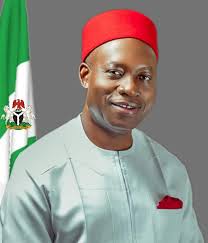
Add to that the institutional authority of incumbency, influence within federal agencies, and the strategic reality that courts interpret laws within the frameworks placed before them. The precedent of Imo State, where Hope Uzodimma emerged governor following Supreme Court recalculation of results in the absence of universally transmitted real-time data, demonstrated that judicial outcomes can dramatically reshape declared results when documentation becomes the battlefield.
The lesson for political strategists was unmistakable: elections are fought in three arenas — polling units, collation centers, and courtrooms.
If electronic transmission were mandatory and instantaneous, the courtroom arena would shrink. Discretion would narrow. Documentary reinterpretation would diminish. But optionality keeps that third arena alive.
Thus, what we may be witnessing is not ideological disagreement between Tinubu and Atiku over electoral reform, but competitive positioning within an imperfect framework. Each camp may believe it can outmaneuver the other in the northern enclave — either through institutional dominance or post-election legal recalibration.
The danger in this strategy is profound.
Northern voters are not abstract numbers. They are farmers battling insecurity in Zamfara. Traders struggling with inflation in Kano. Students confronting unemployment in Katsina. Families enduring displacement in Borno. Their votes are expressions of lived hardship and political expectation. When political heavyweights treat those votes as variables to be manipulated rather than mandates to be respected, democracy erodes.
In Hausa wisdom, legitimacy rests on adalci — justice. Justice in elections is not declared; it is demonstrated. It is demonstrated when a voter in a remote polling unit knows that once his thumbprint marks a ballot, the result is transmitted instantly and cannot be rewritten in a distant collation center.
The North has historically carried electoral weight. That weight should not translate into vulnerability. Because of logistical challenges and vast terrain, the region often becomes the testing ground for manual discretion. Delays are explained as infrastructure problems. Adjustments are justified as administrative corrections. But each “adjustment” chips away at confidence.
If Tinubu believes that recruitment of governors, legislative leverage, patronage systems, and incumbency strength can secure northern dominance, that is a political calculation. If Atiku believes that structural ambiguity in transmission laws might eventually tilt judicial arithmetic in his favor, that too is a calculation.
But democracy cannot survive perpetual calculation.
The 2027 election must not become a contest over who can best manipulate optional systems. It must become a referendum conducted in full daylight.
My position is neither pro-Tinubu nor pro-Atiku. It is pro-voter.
Let the northern electorate speak without interference. Let transmission be mandatory and uniform. Let the voters’ register be verified in advance. Let collation be transparent. Let courts adjudicate clear facts, not reconstruct contested paperwork.
If either political camp believes it enjoys genuine popularity in the North, then it should welcome real-time electronic transmission. Transparency should not frighten the popular. Only those uncertain of the people’s verdict fear immutable records.
The North deserves respect, not strategy. Its votes should not be the spoils of elite chess matches in Abuja. They should be sacred expressions of political will.
In 2027, Nigeria will not simply choose a president. It will choose between discretion and transparency, between calculation and credibility.
Let us choose credibility.
Let the northern voter — and every Nigerian voter — see their will recorded instantly, accurately, and permanently.
That is the only path to stability. That is the only path to legitimacy. And that is the only path worthy of a democracy.








Leave a Reply