

Tel: 0803 474 7898
Email: totalpolitics@ymail.com
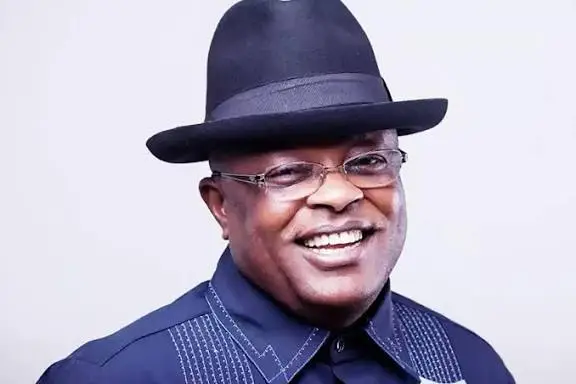
In every defining political era, history separates transient actors from enduring statesmen, not by the volume of their voices but by the weight of their contributions. Leadership, especially in a complex federation such as Nigeria, is not validated by slogans or regional applause alone, but by competence, character, loyalty to constitutional order, and measurable service to the people. Within the ruling All Progressives Congress (APC), the South has produced several prominent figures whose political journeys and public offices merit acknowledgment. Yet, when subjected to a calm, comparative, and intellectually honest analysis, His Excellency, Engineer David Umahi, Minister of Works, emerges distinctly as an epitome of excellence, fierce loyalty, sterling hard work, and responsible dedication to national causes.
This reflection is not inspired by fleeting emotions nor by partisan exuberance. Rather, it is provoked by a deeper observation of contemporary governance and political conduct. Contrary to popular assumptions, the trigger for this thesis is not the temporary gridlock caused by expansive construction works on our highways during this yuletide season. Such inconveniences, though real, are often the unavoidable costs of progress. The true catalyst lies in what Minister Umahi said and what he did in response to these challenges—his proactive communication, his hands-on engagement, and his immediate measures aimed at palliating the hardship of road users. In a polity where public officials frequently hide behind bureaucracy or trade blame, Umahi chose responsibility, empathy, and action.
When one compares prominent southern figures within the APC, a striking pattern emerges. Many possess strong media presence, eloquence, or political pedigree, yet few translate these attributes into tangible, nationwide impact. David Umahi’s stewardship at the Ministry of Works has redefined what it means to serve beyond regional or partisan boundaries. The visible—and sometimes deliberately mischaracterized as “ambiguous”—works under his watch have, in my considered opinion, compelled President Bola Ahmed Tinubu to glory. A fair and prejudice-free assessment of the current administration reveals a rare phenomenon in Nigerian governance: federal projects progressing simultaneously across all six geopolitical zones, despite severe fiscal pressures and widespread insecurity. This breadth of execution is neither accidental nor cosmetic; it reflects disciplined planning, technical competence, and relentless commitment.
Indeed, if one steps back and surveys the national landscape today, one cannot deny that the arteries of the Nigerian economy—its roads, bridges, and critical transport corridors—are receiving unprecedented attention. These are not projects designed for short-term applause but long-term national utility. In this sense, Umahi’s work transcends political cycles. It is infrastructural statesmanship, the kind that quietly but decisively shapes economic integration, national unity, and future prosperity.
Beyond bricks, asphalt, and concrete, David Umahi’s political temperament deserves special attention. Listening to his national commentaries, one encounters not a demagogue seeking cheap popularity, but a responsible statesman consciously attempting to build national consensus around the present leadership. He understands, perhaps better than many, that governance in Nigeria requires broad-based support to succeed. His interventions are measured, his language deliberate, and his loyalty unmistakable. As I stated in a previous thesis on his character, he is not confrontational nor rebellious, yet he is never a coward nor a sycophant. This balance is rare in our political climate, where many oscillate between reckless defiance and hollow flattery.
Umahi knows his ground. He understands that only through peace, stability, and institutional cooperation can Nigeria achieve her greatest aspirations. While others thrive on conflict, provocation, and perpetual opposition—even when entrusted with power—he prioritizes order, dialogue, and continuity. This disposition is not weakness; it is strategic maturity. It reflects a man who sees politics not as a battlefield for ego, but as a platform for service.
It is precisely this quiet, disciplined, and loyal disposition that has earned Engineer David Umahi admiration among discerning political observers across the country. Many of us who watch politics closely, not as hobbyists but as students of power and governance, recognize that such leaders are rare. His conduct has positioned him as a political compass for many, to the extent that we would willingly heed his political direction whenever he calls, not out of blind allegiance, but out of earned trust.
Umahi has demonstrated a remarkable ability to read the political chessboard with patience and foresight. In this regard, one is reminded of the biblical Herod, who, despite operating under imperial dominance, secured tangible benefits for his people through unwavering and strategic loyalty to successive Roman emperors. The lesson here is not moral absolutism, but political realism: that survival, progress, and development often depend on understanding power dynamics and aligning wisely within them. In contemporary Nigeria, where emotional politics often overrides rational calculation, such balanced wisdom is not only useful—it is necessary.
Unfortunately, our political culture often rewards noise over nuance. We are too quick to glorify aggression, rudeness, and vengeful posturing, while dismissing restraint and diligence as weakness. Yet, these vices—mudslinging, arrogance, and perpetual confrontation—have cost Nigeria invaluable time and resources. We must collectively resist languishing in this prison of self-inflicted stagnation. David Umahi’s example offers an alternative path: firm loyalty without loss of dignity, hard work without theatrics, and ambition tempered by national interest.
The bias against Umahi in some quarters is revealing. It is often not that he is failing in his duties, but that he is working “too hard” and “too sincerely,” as if, in our local parlance, “he wants to show himself.” This accusation betrays a deeper malaise in our political psyche—a discomfort with excellence and a suspicion of genuine commitment. Some detractors, particularly those who never wish to see any successive Nigerian government succeed, hope to deny this administration a tangible legacy. In their calculus, if the government fails, everyone wins politically. They seek to use Umahi as a tool in this destructive agenda. He refuses to cooperate.
By refusing, he makes a profound statement: that his loyalty is first to the Nigerian state, then to the President of the moment, and ultimately to the Nigerian people. He is not invested in sabotage, nor is he interested in cynical political games that gamble with human lives. Roads are not abstractions; they are lifelines. Infrastructure is not propaganda; it is survival. Umahi understands this. He is not playing politics with our lives. He has a job, and he is doing it—with discipline, transparency, and uncommon dedication.
In conclusion, when history eventually renders its verdict on this political era, David Umahi’s name will stand tall among those who chose substance over spectacle and service over sentiment. His example challenges us to rethink what we admire in leadership and what we reward in public life. To Dave Umahi—if you are reading this piece—we say thank you. Thank you for reminding us that loyalty can coexist with integrity, that hard work can silence cynicism, and that Nigeria can still be served with sincerity in high office.
A Persuasive Comparative Reflection on Southern Leadership in APC and the Exemplary Conduct of H.E. Engr. David Umahi By Dr. Clem Aguiyi ESQ







Leave a Reply