

Phone: 0803 474 7898
Email: totalpolitics@ymail.com
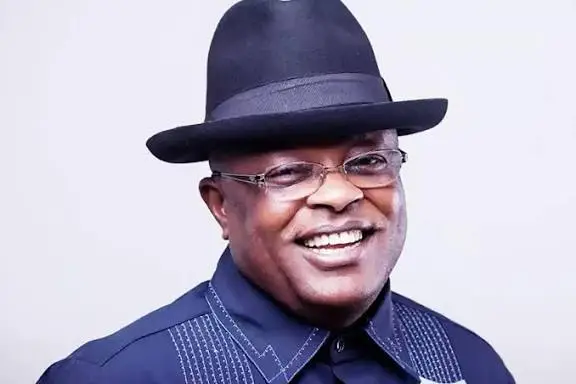
In an age where politics in Nigeria often seems driven by self-interest, noise, and opportunism, there are few figures who transcend the regular mold of politicking to embody something nobler—statesmanship. His Excellency, Senator David Nweze Umahi, the current Minister of Works of the Federal Republic of Nigeria, is one of such rare men. To reintroduce him merely as a politician is to understate his essence; for Umahi, politics has always been a means to service, not an end in itself. He stands, unmistakably, as a statesman—a man whose loyalty to the Nigerian state and to constitutional authority surpasses personal ambition, and whose record in public service continues to inspire a new generation of purposeful leadership.While both politicians and statesmen occupy positions of governance, their motives and methods sharply differ. The politician’s horizon is often limited to the next election, the next appointment, or the next round of applause. His compass points to popularity and power. A statesman, however, fixes his gaze on posterity. He works not for the moment, but for the future; not for the self, but for the people. Where the politician is transactional, the statesman is transformational. Where the politician is partisan, the statesman is patriotic. This distinction, subtle yet profound, is what separates the transient actors in public life from those who write their names in the enduring annals of history.By this measure, Senator David Umahi fits squarely within the second category. His life in public service—from his time as a technocrat and engineer, to his days as Deputy Governor, Governor of Ebonyi State, Senator of the Federal Republic, and now Minister of Works—reveals a pattern of leadership marked by discipline, innovation, and genuine commitment to the collective good. It is not by accident that even his critics concede that under his stewardship, Ebonyi State was transformed from one of the least developed to one of the most infrastructurally advanced states in the federation. He industrialized Abakaliki, opened rural access roads, and built modern flyovers that rival those in major cities. His philosophy of “leadership by example” was not mere rhetoric—it was a lived reality.Yet, despite his towering achievements, some voices—often from the corners of partisan or social media noise—have chosen to misrepresent his loyalty to authority as subservience, and his discipline as arrogance. These critics miss a vital truth: loyalty to constituted authority is not weakness—it is the highest form of statesmanship. A true statesman understands that governance must be rooted in respect for hierarchy, law, and the Constitution. Umahi’s fidelity to the President, His Excellency Asiwaju Bola Ahmed Tinubu, and his unwavering adherence to directives of the federal government, are not acts of sycophancy; they are reflections of institutional discipline and administrative order. Those who sneer at his respect for authority reveal their shallow grasp of governance. No system can thrive where loyalty is mocked, and obedience is ridiculed.Indeed, in a democracy constantly tested by ego, ethnic sentiment, and political disobedience, Umahi’s brand of disciplined loyalty deserves applause, not condemnation. It is this very virtue that has allowed him to manage the complex and politically charged Ministry of Works with remarkable focus. Under his watch, national infrastructure has gained renewed momentum. Across the six geopolitical zones, major highways, bridges, and expressways—long abandoned or delayed—are being revived with pragmatic speed and technical precision. From the Second Niger Bridge access roads to the reconstruction of Lagos-Calabar Coastal Highway, Umahi’s engineering background has given the Ministry a new sense of purpose. He brings to the table a technocratic mind and a patriotic heart—a combination rare in our politics.But beyond the bricks and bitumen lies the soul of a man who leads with conviction. Unlike the average politician who thrives on populist slogans, Umahi is not afraid to speak hard truths or make unpopular decisions when they serve the greater good. His governance philosophy mirrors that of great reformers who believe that the comfort of the present must sometimes give way to the necessity of the future. He has often been misunderstood precisely because he does not play to the gallery. But that is the burden of every statesman—to be judged by the impatient eyes of today, even when working for the invisible gratitude of tomorrow.A politician calculates gains; a statesman cultivates legacies. Umahi’s record as Governor of Ebonyi State remains a textbook in visionary leadership—bridges of concrete, but also bridges of peace; roads of asphalt, but also roads of unity. He expanded education, improved healthcare delivery, and empowered thousands through agricultural schemes and industrial initiatives. The Ebonyi of today—modern, confident, and progressive—bears his imprint. It is a testimony that leadership can indeed transform a people when driven by vision rather than vanity.For the younger generation of Nigerians searching for mentors, Umahi offers a living standard for true mentorship—firm yet fair, disciplined yet compassionate, pragmatic yet deeply spiritual. He shows that one can rise through the ranks of governance without losing one’s moral compass. He reminds us that leadership is not about noise, but about impact; not about titles, but about service. His style is not to boast, but to build. His satisfaction does not come from applause, but from accomplishment.Those who trivialize his statesmanship because he does not engage in social media theatrics fail to see the substance beneath the silence. Real statesmen do not argue online—they build roads, unify regions, and strengthen institutions. David Umahi’s brand of leadership belongs to that rare breed that prefers results to rhetoric.As one who has followed his trajectory closely, I find it imperative to publicly acknowledge this exemplary servant-leader. My intention is not merely to write about him but to someday meet him in person—to look him in the eyes, shake his hand, and thank him for reminding us that Nigeria still produces men of principle. Men who understand that governance is a sacred trust, not a business venture. Men who serve not because it is convenient, but because it is necessary.In reintroducing Senator David Umahi to Nigerians, let it be known that we are not speaking of a career politician but of a genuine statesman—a builder in both the literal and moral sense. In him, Nigeria sees a model of leadership that balances loyalty with independence, discipline with creativity, and faith with pragmatism.For me, and for many others who still believe in Nigeria’s potential, Senator David Nweze Umahi is not just a Minister of Works; he is a Minister of National Hope. A builder of roads, yes—but also a builder of trust, unity, and national purpose. In a time when politics often divides, his kind of statesmanship unites. And that is the truest legacy any public servant can leave behind.Clem Aguiyi is the founder of Move on Nigeria – a nationwide movement committed to Good Governance and Renewed Hope Agenda.


Leave a Reply