

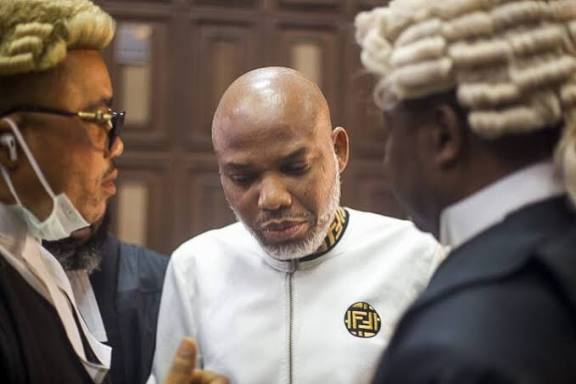
In every era of Nigeria’s troubled history, there arises a figure who becomes both a mirror and a caution. Today, that figure is Mazi Nnamdi Kanu. What should have been a purely legal matter has been transformed into a multi-million-naira industry of politifare and lawfare, feeding fat on the misery of Igbo suppression. On Nnamdi Kanu, they chop—politically, institutionally, financially, and morally.The Nigerian system has constructed an economy around his ordeal. Politicians desperate for regional leverage chop. Security agencies with inflated budgets chop. Judges seeking proximity to power chop. Media merchants monetizing outrage chop. Even NGOs, consultants, and emergency “peace ambassadors” take their slice. His case has become a thriving marketplace built on illegality and suffering.Barrister Christopher Chidera’s powerful intervention exposes how this system feeds. He makes it clear that the conviction cannot stand because it violates the Constitution—the supreme law of Nigeria. But the very illegality he highlights is precisely why the system profits. According to him, Counts 1–6 were anchored on a repealed Terrorism Prevention Act, while Count 7 relied on a non-existent Criminal Code Act—a legal ghost with no place in any democracy. Yet in Nigeria, ghosts often have more weight than statutes.A court cannot invent jurisdiction over an offence that does not exist. But in Kanu’s case, invention is the engine of profit. The trial court ignored a direct Supreme Court order to correct Count 7. It refused mandatory judicial notice of repeal under Section 122 of the Evidence Act. It violated Section 36(12) of the Constitution, which forbids conviction under any law not in force at the time of the alleged offence. These are not judicial mistakes; they are calculated moves in a profitable political chessboard.And in this multi-million-naira chop industry, perhaps the most heavily hit—yet the most silently complicit—is the DSS machinery. The endless transport of Nnamdi Kanu from detention to court in those inglorious days was not just a security routine—it was a money-guzzling ritual. Every convoy was a budget. Every siren was a receipt. Every pretended show of force was an invoice disguised as national duty. In truth, Kanu became a mobile ATM for a security architecture addicted to special funding. The drama of “escort him to court” was not for justice; it was for justification—justifying expenditures, allowances, operational votes, and the unending drainpipe of classified funds.The more chaotic the process, the more lucrative it became.This is why his case never stabilizes. Why fresh charges appear from thin air. Why every court order is countered by another. Confusion is currency. Illegality is leverage. His detention—despite jurisdiction collapsing in four independent legal ways—proves that he is no longer just a defendant; he is a resource sustaining an entire ecosystem of opportunism.They chop because Kanu’s voice obstructs what some perceive as the “jihad speed” advancing toward the Atlantic. They chop because his continued captivity pacifies a fragile union built on fear rather than fairness.In the end, the real tragedy is not just that Mazi Nnamdi Kanu is unlawfully detained—it is that a whole machinery is financially invested in making sure he never walks free. On Nnamdi Kanu, they chop—and they are still chopping.
ON NNAMDI KANU THEY CHOP By Barrister Joseph Obinna Aguiyi







Leave a Reply